- 24/04/2026
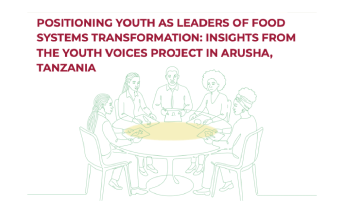
Young people are an influential force in food systems, particularly in low- and middle-income countries, yet their perspectives remain underrepresented in policy and decision-making.
This case study explores how youth leadership programmes can strengthen young people’s understanding of food systems, develop their leadership and communication skills, and enable them to engage meaningfully with stakeholders across multiple levels. It illustrates how experiential learning, peer collaboration, and opportunities for collective action allow youth to influence decision-making, advocate for inclusive reforms, and contribute to sustainable transformation.
The study highlights how positioning young people as active participants in food systems can gain traction and considers how such approaches could be scaled and institutionalised to ensure that youth perspectives are systematically integrated into food system initiatives.
- 24/04/2026
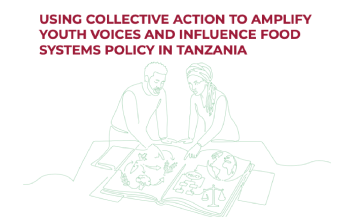
Young people represent a critical yet underutilised force in transforming food systems. This case study examines how youth-led collective action campaigns can serve as a mechanism to amplify youth voices and influence food system
transformation. It shows how young people can engage with decision-makers at both local and national levels to shape agendas, embed inclusivity, and create opportunities for meaningful participation in policy processes. This case underscores how collective action can reposition young people as active agents of change in food system policy and offers insights on how policymakers and stakeholders can support the integration of youth perspectives into formal decision-making structures.
- 25/03/2026
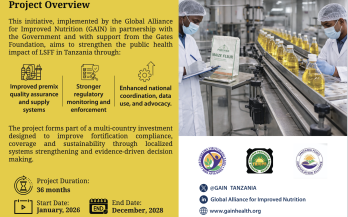
Tanzania has established a strong policy and regulatory framework mandating the fortification of staple foods, including wheat flour, maize flour, edible oils, and salt. Despite this progress, implementation and compliance gaps persist, limiting the public health impact that fortification programmes can achieve Market evidence and engagement with Millers for Nutrition (M4N) highlight that inconsistent compliance and coverage stems from structural barriers within Tanzania’s fortification ecosystem.
- 25/03/2026
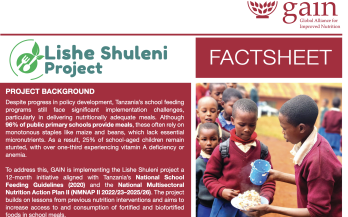
Despite progress in policy development, Tanzania’s school feeding
programs still face significant implementation challenges, particularly in delivering nutritionally adequate meals. Although
96% of public primary schools provide meals, these often rely onmonotonous staples like maize and beans, which lack essential micronutrients. As a result, 25% of school-aged children remain stunted, with over one-third experiencing vitamin A deficiency or anemia.
- 26/02/2026
I-CAN Policy Brief, June 2025. This policy brief highlights the challenges and opportunities arising from the need to better integrate climate and nutrition policies in Tanzania. Despite growing recognition of their interconnectedness, policies remain largely fragmented and operate in silos, particularly across health, nutrition, and other food systems sectors. Food and agriculture policies lead in climate-nutrition integration by including concrete strategies and accountability mechanisms. However, outdated legacy policies, weak institutional coordination, and fragmented financing and data systems hinder effective integration and implementation. Key barriers include limited cross-sectoral collaboration, under-resourced coordination structures, and lack of shared data and financing mechanisms. Recommendations include establishing a national Climate–Nutrition Coordination Committee, implementing integrated financing tracking, adopting joint monitoring indicators, and promoting inclusive stakeholder engagement to strengthen policy coherence and accelerate impactful climate-nutrition action in Tanzania.
- 11/10/2025
Youth in Tanzania are active at the community level but remain largely absent from formal
governance. There is potential for Tanzanian youth to more actively help Tanzania in its ambition to
achieve a nutrition-sensitive, climate resilient, inclusive food system.
- 03/06/2025
The food safety regulatory framework in Tanzania is characterized by the absence of a comprehensive, overarching policy framework dedicated solely to food safety. Instead, food safety governance is fragmented across various laws and regulations managed by different institutions each addressing specific aspects of food safety.
- 16/05/2025
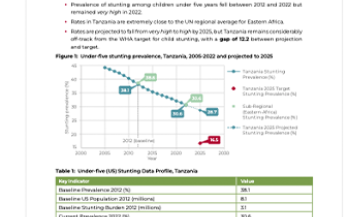
WHA Global Nutrition Stunting Target 2012-2025
Achieve a 40% reduction in the number of children under-5 who are stunted
WHA Global Nutrition Overweight Target 2012-2025
Ensure that there is no increase in childhood overweight
- 23/05/2024
Buguruni market is a traditional food market in Dar-es-Salaam, Tanzania with about 2,630 vendors selling their produce to about 70,000 consumers daily. In a rapid assessment conducted in 2020, almost a third of consumers reported concerns related to food safety when shopping in the market.
- 17/10/2022
The launch of the National School Feeding Guideline offers a strong lifeline to scale the provision of nutrient-dense fortified foods in schools.