- 07/08/2026
Crowdsourcing, i.e., leveraging digital platforms to mobilise distributed contributors for
data collection, harnessing the collective power of large, distributed networks of people to accomplish such tasks through open calls has gained traction in recent years, yet practical guidance for implementation in low- and middle-income countries (LMICs)
remains limited. This paper examines lessons from three food systems research case
studies conducted by the Global Alliance for Improved Nutrition in Indonesia and Kenya
between 2019-2024, analysing what worked, what didn't, and why.
- 08/07/2026
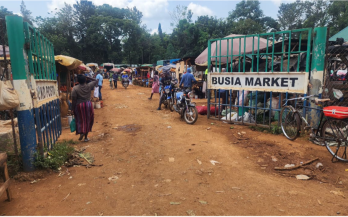
Traditional food markets are central to Kenya’s food systems, providing fresh and affordable food to consumers as well as jobs, income, and livelihoods to farmers and traders. However, despite Kenya’s strong food policy environment, governance of traditional food markets is often weakly integrated and under-prioritised. This prevents unlocking the markets’ full potential for food security, nutrition, and inclusive growth. This briefing paper examines governance in three traditional food markets in Bungoma and Busia County, Western Kenya, using a mixed-methods approach combining key informant interviews, vendor surveys, direct market observations, participatory workshops, and a review of relevant policy and governance documents to assess how governance arrangements shape market performance.
- 06/02/2026
This report summarizes the key findings from the Kenya policy landscaping analysis and stakeholder mapping analysis and provides recommendations for better policy integration in Kenya in support of the Initiative on Climate Action and Nutrition (I-CAN).
- 06/02/2026
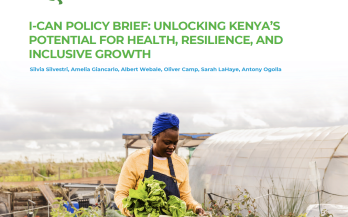
Climate change and malnutrition are deeply intertwined challenges in Kenya, where climate related
shocks continue to threaten food systems, health services, and vulnerable populations. This policy brief summarizes f indings f rom a rapid assessment of 27 national policies and key stakeholder interviews, conducted to support the I-CAN initiative. The analysis reveals uneven climate–nutrition integration across sectors, with strong implementation f rameworks in some policies but persistent gaps in coordination, data systems, and f inancing. Overreliance on donor funding, limited engagement of diverse stakeholders, and underutilized governance structures further hinder progress. At the same time, there are clear opportunities to strengthen policy
alignment, institutional reform, cross-sector collaboration, and stakeholder inclusion to build a more resilient and nutrition-secure Kenya.
- 08/09/2025
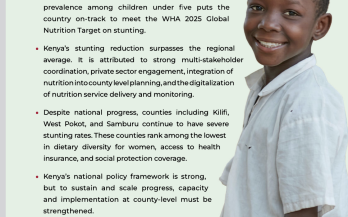
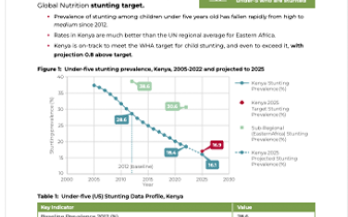
Stunting is a major concern in Eastern Africa, where nearly 1 in 3 children under 5, about 22.6 million, are
affected (UNICEF, WHO, Worldbank, 2023). In Kenya, the prevalence has declined to approximately one in
five children (18%), outperforming the regional average of 31.6%. However, this still represents more than
1.2 million children at risk (KNBS, Ministry of Health, ICF, 2023). The consequences are far-reaching;
stunting contributes to child mortality, vulnerability, and lifelong impairments in physical growth and
cognitive development, impacting both individual well-being and national productivity. In Kenya, child
undernutrition, including stunting as a key component, is estimated to cost the economy KES 374 billion
(approximately USD 4.2 billion) annually, equivalent to 6.9% of the GDP (Government of Kenya, 2019).
Stunting, a persistent form of long-term nutritional deprivation, acts as a silent driver of inequality, limiting
opportunities, lowering future earnings and reducing the potential to contribute equally to the economy.
Yet the returns on investment in nutrition are high, with every dollar yielding up to $22 in economic
benefit. (Eberwein, et al., 2016)
- 25/07/2025
Kenya’s engagement in food systems transformation reflects a strong policy commitment and growing political will to address persistent food and nutrition security challenges. This ambition is evident in progressive national frameworks such as the National Food and Nutrition Security Policy (2011), Agricultural Sector Transformation and Growth Strategy (2019–2029), Agricultural Soils Management Policy (2023), and the newly launched National Agroecology Strategy for Food System Transformation (2024–2033).
These strategies are aligned with global and regional commitments, including the Sustainable Development Goals (SDGs), the Paris Agreement on climate change mitigation, and the Malabo Declaration on comprehensive African agricultural development, signalling Kenya’s intention to lead in advancing climateresilient and equitable food systems.
- 03/06/2025
The world is facing multiple interconnected crises, including climate change and escalating conflicts, which pose significant challenges to food systems. These issues highlight the need for systemic transformation to improve food security, nutrition, and environmental sustainability. In response, GAIN's Nourishing Food Pathways (NFP) programme aims to strengthen and support the implementation of food system pathways in 11 countries.
- 16/05/2025
WHA Global Nutrition Target 2012-2025
Achieve a 40% reduction in the number of children under-5 who are stunted
Overweight Target 2012-2025 Ensure that there is no increase in childhood overweight
- 09/04/2025
On March 27th and 28th, 2025, France hosted the Nutrition for Growth Summit (N4G) in Paris. Launched in 2013 in London, N4G is a flagship international conference aimed at securing concrete political and financial commitments to combat malnutrition in all its forms. N4G brings together governments, international organisations, philanthropies, businesses, NGOs and other key stakeholders at a global and regional level to elevate nutrition as a key development agenda and accelerate progress against malnutrition.In preparation for the 2025 Nutrition for Growth (N4G) Summit, The Global Alliance for Improved Nutrition (GAIN) in collaboration with The Scaling Up Nutrition (SUN) Movement, the Ministry of Health of Kenya, and other stakeholders, hosted several dialogues over the past months bringing together participants representing a diverse array of sectors, including civil society organizations, private sector (e.g. food production businesses), policy-makers and media. The primary objective was to mobilize and inspire Kenyan government representatives to review and develop Kenya's commitments for the 2025 N4G Summit while reflecting on the commitments it made as a nation during the 2021 Summit.
- 06/01/2025
NUTRITION IMPACT AT SCALE (NIS) Through the Nutrition Impact at Scale project, GAIN seeks to scale the impact of its work to increase access to safe and nutritious foods, especially for low-income consumers. By working with other organisations (Enterprise Support Organisations) that are willing and have the requisite capacity to attach a 'nutrition lens' to their work with small and medium enterprises (SMEs), Nutrition Impact at Scale (NIS) will enable a large-scale and accelerated nutrition impact for the larger African population. Funded by the Ministry of Foreign Affairs of the Netherlands, NIS uses a market systems development approach to improve food systems, increase inclusivity, and, ultimately, nutrition outcomes. The project leverages on the extensive experience GAIN have developed over the years of providing quality technical assistance, networking experience, knowledge sharing, building capacity of partners, and the provision of various tools and resources to MSMEs, to attach a 'nutrition lens' to the work of ESOs in Nigeria, Benin, Uganda, Ethiopia, Mozambique, and Kenya.