Screening Foods for Nutrition, Safety, and Sustainability
GAIN’s mission and strategy are driven by a commitment to advance nutrition outcomes by improving access to and demand for nutritious and safe foods that are produced and consumed sustainably. Central to this approach is also ensuring that the food-based solutions* GAIN actively promotes are affordable, especially to those most vulnerable to malnutrition, culturally acceptable, and within reach for target population groups.
* Food-based solutions include macro- and micronutrient supplements, food groups and single foods, meals and recipes, and whole diets.
Introducing GAIN’s Nutritious, Safe, and Sustainable Foods Screening Process
The Nutritious, Safe, and Sustainable Foods (NSSF) Screening Process is a practical tool that helps GAIN programmes make informed decisions about which food-based solutions to promote and invest in. It operationalizes GAIN’s definition of Nutritious and Safe Foods by ensuring that the chosen solutions address specific dietary challenges, are of adequate nutritional quality, and minimize food safety and environmental concerns.
Instead of a one-size-fits-all approach, the Screening Process enables GAIN teams to assess solutions in context, considering the specific population groups and geographies targeted and evaluating factors like accessibility, affordability, and cultural acceptability. This ensures that the selected solutions are optimized leading to greater cost efficiencies and potential benefit for the populations we serve.
Our recent work across GAIN programmes demonstrates the wide applicability and added value of the NSSF Screening Process.
In India, for example, GAIN worked on a social protection initiative to develop nutrient dense low-cost recipes for take-home rations for mothers and children in Bihar. Using the Screening Process, the team assessed the dietary and nutritional challenges faced by the target populations within the local geographic context.
Key questions guided the analysis: Which food combinations and meals meet requirements for protein, energy, vitamins, and minerals, without providing excessive salt, fat, or sugar? Are the ingredients used locally available, will they be safe for consumption in the way they are produced, will beneficiaries of the programme find the rations desirable and will the final product fall within the cost constraints of the government subsidy?
By evaluating the proposed food-based solutions across multiple dimensions, including nutritional value, food safety, local ingredient sourcing, and taste preferences, the Screening Process supported evidence-based decisions on recipes that are most likely to make a difference.
Similarly, in Nigeria, a project was designed to address low dietary diversity in selected districts. The screening process guided the team in analysing consumption levels of nutrient-dense foods to identify gaps and assess which value chains would offer the greatest potential impact. The evaluation revealed low egg consumption among women and children, alongside moderate vegetable intake and very high meat consumption. Based on these findings, the egg value chain was prioritised and further screening for safety, environmental implications, local availability, affordability, and acceptability.
How does the Screening Process work?
The Screening Process follows a structured, step-by-step approach to identify, assess, and monitor food-based solutions throughout the entire project cycle, from design and proposal development to implementation and continued quality improvement. It can also help teams working with small- and medium-sized enterprises (SMEs) decide which businesses and products to support, as well as improve formulations of commercial foods, develop recipes, optimize menus, and determine which food groups to prioritize in nutrition education campaigns.
The five key stages of the Screening Process are:
- Identify the health / nutritional or dietary challenge: Programme teams map the local context by defining the target population and geographical scope, and explore the core health / nutritional (e.g., stunting, anaemia, obesity) or dietary challenge (e.g., low dietary diversity, overconsumption of unhealthy foods) their project aims to address.
- Map potential food-based solutions: Teams consider a range of options, from fortified products and supplements to inherently nutrient-dense foods / food groups, complex meals, and whole diets, that could help address the identified dietary challenges within the target populations and geographies.
- Screen solutions for core risks and benefits for nutrition, food safety, and the environment: Each option is evaluated for its nutritional value, food safety concerns, and environmental impacts to maximize benefits and contain risks for people and planet. Tools such as traffic-light scoring systems and calculators to examine (ultra-)processed foods’ nutritional quality are available to support this assessment.
- Assess feasibility and relevance in context (availability, affordability, acceptability): Solutions are evaluated for real-world applicability within the target populations and geographies, including accessibility, cost, and cultural appropriateness.
- Refine the selected solution to optimize food safety and desirability, while minimizing environmental impact: Teams identify ways to improve the social desirability of the chosen solution, while ensuring it is safe to consume for the target populations, and environmentally sustainable (i.e., by reducing negative impacts and enhancing co-benefits).
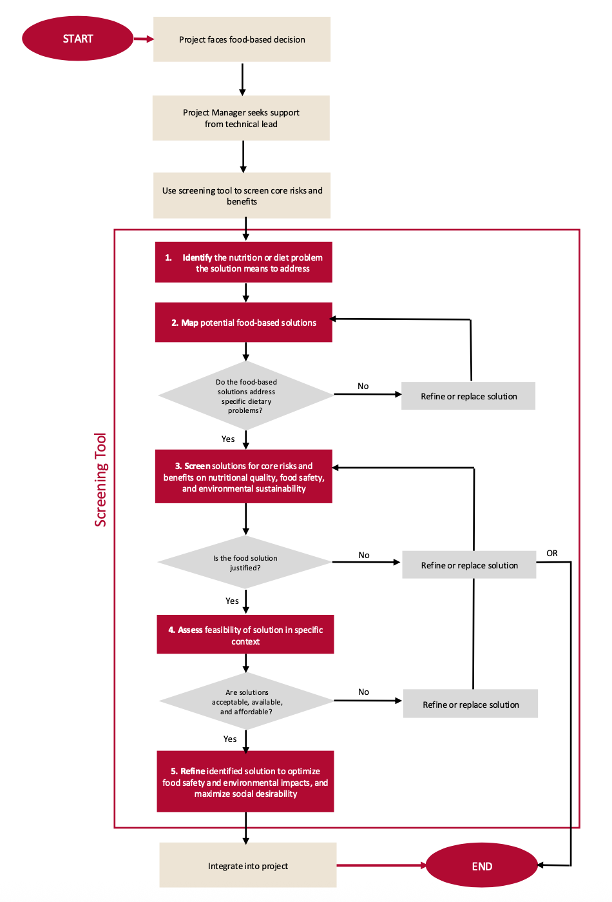
The Screening Process starts with the need to identify a food-based solution and ends with the selection of a solution that is evidence-based, well justified, and aligned with GAIN’s strategic priorities across nutrition, food safety, and the environment.
Working Group Members & Senior Management Team Support

Christina Nyhus Dhillon
Research Lead-Healthy Diets, Knowledge Leadership, GAIN

Stella Nordhagen
Research Lead, Food Environments and Supply Chains

Flaminia Ortenzi
Senior Research Associate

Jessica Colston
Lead, Environment and Nutrition

Ariel Garsow
Food Safety Lead, Technical Advisor – Policy and Governance

Ty Beal
Senior Technical Specialist

Valerie Friesen
Research Advisor, Knowledge Leadership, GAIN

Sunaina Chander
Consultant

Taotao Li
Junior Associate - Environment

Mduduzi Mbuya
Director, Knowledge Leadership

Penjani Mkambula
Chief Technical Officer