Initiative on Climate Action and Nutrition (I‑CAN)
I‑CAN aims to catalyse climate action for nutrition benefits, and nutrition action for climate benefits
I‑CAN aims to catalyse climate action for nutrition benefits, and nutrition action for climate benefits
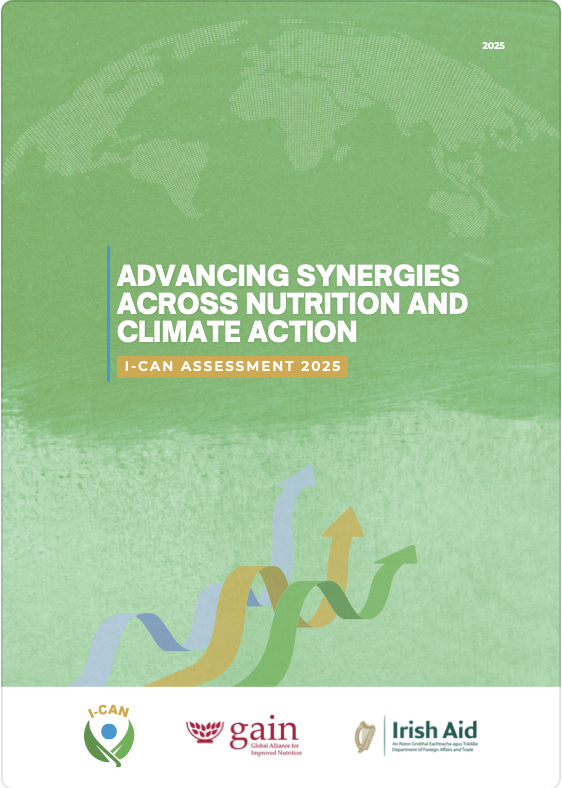
The I-CAN Assessment 2025 aims to provide a snapshot into the current state of integration between climate and nutrition action across 16 indicators in policy and finance. Despite modest progress since 2023, the report makes clear that integration of climate and nutrition in key international and national policies and financing remains limited, slowing progress towards both reducing malnutrition and climate goals.
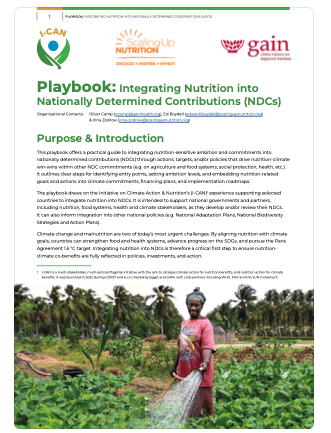
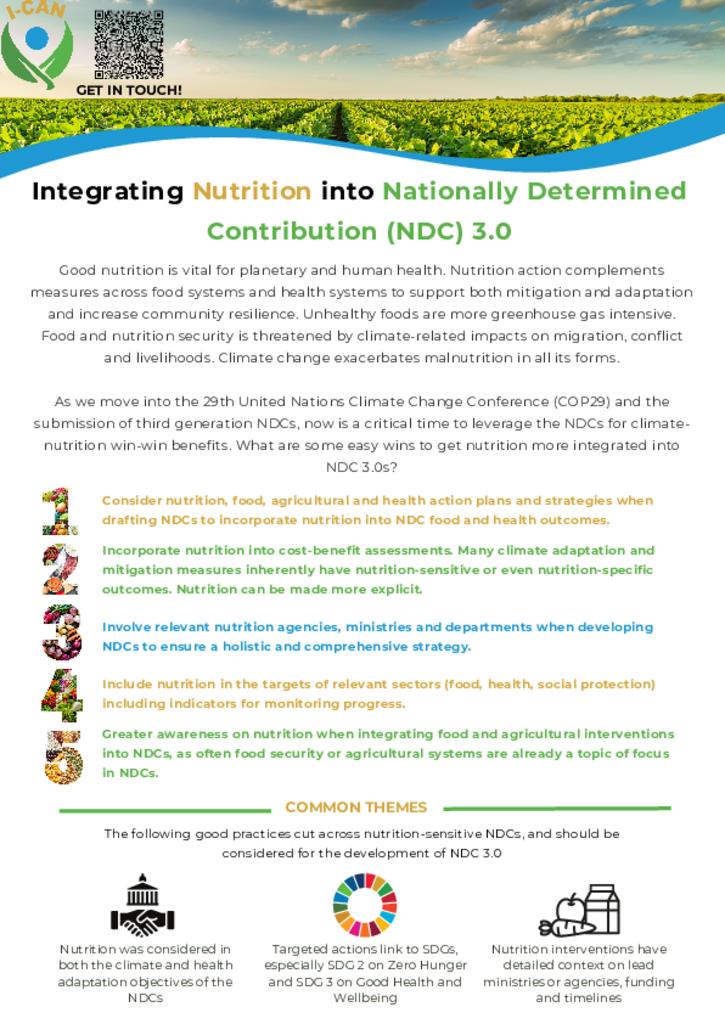
I-CAN presents a new playbook offering step-by-step guidance to embedding nutrition-sensitive ambition and action into nationally determined contributions (NDCs). Drawing on I-CAN experience support climate-nutrition integration in different countries, it highlights practical entry points, resources, and provides policy examples to create nutrition–climate win-wins across food systems, health, agriculture, and social protection. By aligning nutrition with climate goals, countries can strengthen food and health systems, advance progress on the SDGs, and pursue the Paris Agreement 1.5 °C target.
The Initiative on Climate Action and Nutrition (I-CAN) presents a new report that analyses the intersection of biodiversity and nutrition, "Biodiversity and Nutrition Synergies: Evaluating National Biodiversity Strategies and Actions Plans for Integration." The report offers a comprehensive analysis of 192 National Biodiversity Strategies and Action Plans (NBSAPs), revealing the current state of nutrition integration in biodiversity policies worldwide.
The study highlights a significant gap: 62% of NBSAPs show no intentional connections between biodiversity and nutrition. It uncovers regional variations, with Latin America and the Caribbean, Sub-Saharan Africa, and South and East Asia and the Pacific demonstrating higher integration levels, though overall progress remains limited. It looks at how biodiversity and human health are connected. This study is a valuable tool for people working on both environmental and nutrition issues. It offers useful ideas to help make policies and practices better.
I-CAN was launched in 2022 during COP27 by the Presidency of Egypt, and is co-chaired by Egypt and GAIN, with core partners including WHO, FAO and the SUN movement. I-CAN gained significant attention in 2023, being featured at various high-level international events and mentioned by the Director-Generals of both WHO and FAO during COP28 in Dubai. In 2024, I-CAN will focus on providing national-level support to country governments.
Please click here to read the key findings and full pdf of the I-CAN 2023 baseline report, which highlights the current state of integration between climate change and nutrition across a range of indicators, including in action, data and evidence, policies, and investments.
The Executive Summary of the I-CAN baseline report is available also in French, Spanish and Arabic.
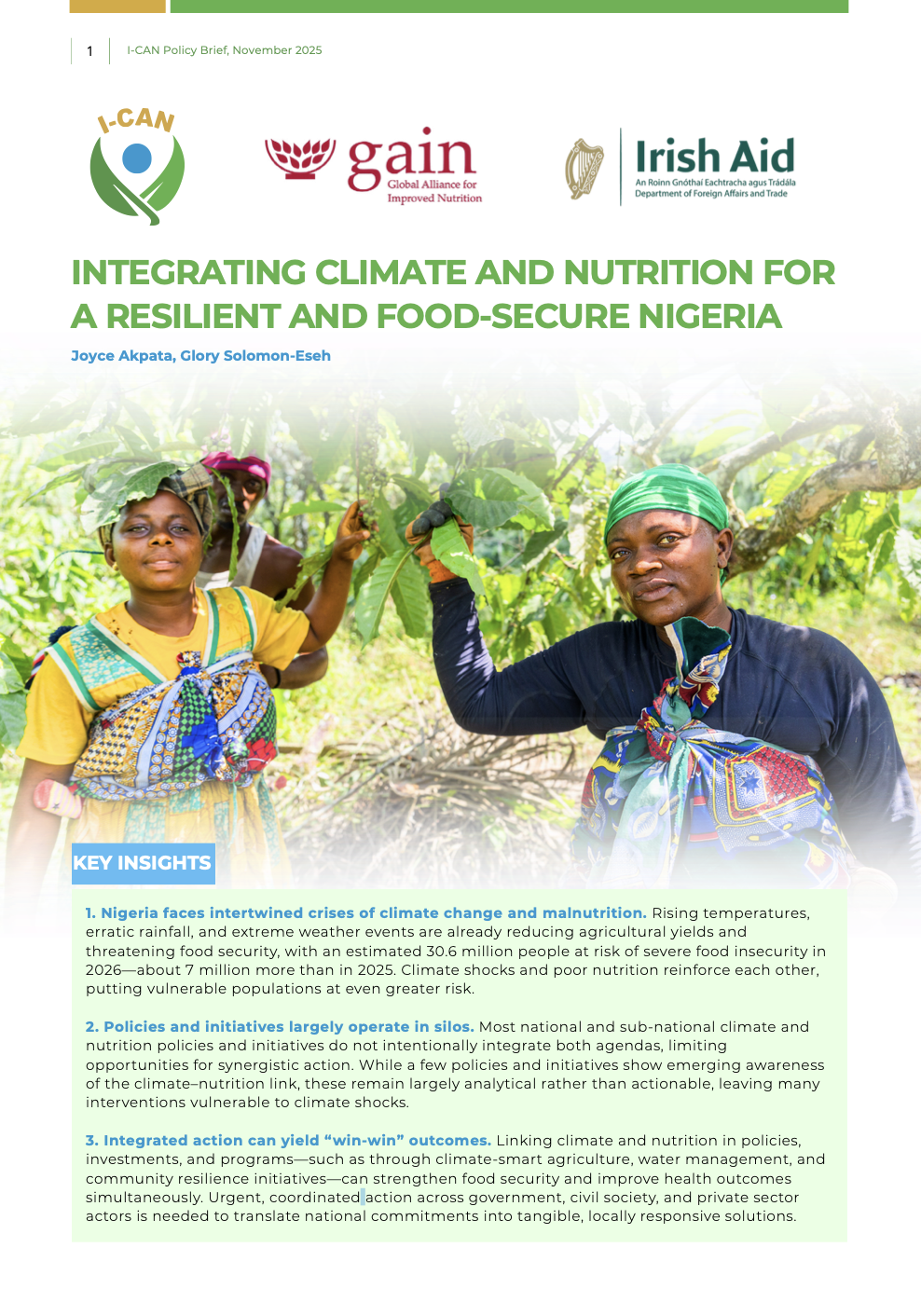
Nigeria’s climate and nutrition challenges are deeply interconnected, yet responses remain largely fragmented. Climate shocks are already undermining agricultural productivity and worsening food insecurity, placing millions more Nigerians at risk each year. This brief highlights how siloed climate and nutrition policies limit effective action and makes the case for integrated approaches that deliver “win-win” outcomes. By aligning climate and nutrition priorities across policies, investments, and programmes, Nigeria can strengthen food security, protect vulnerable populations, and build more resilient food systems.
Nigeria is facing a growing crisis at the intersection of climate change and nutrition. Rising food insecurity, escalating climate risks, and persistent malnutrition are placing millions at risk. This policy brief draws on evidence generated under the Initiative on Climate Action and Nutrition (I-CAN) to highlight how climate shocks are undermining food systems and nutrition outcomes in Nigeria. It presents actionable insights to support the integration of climate and nutrition considerations into national and subnational policies, programmes, and investments, with a focus on building resilient food systems and improving nutrition outcomes.
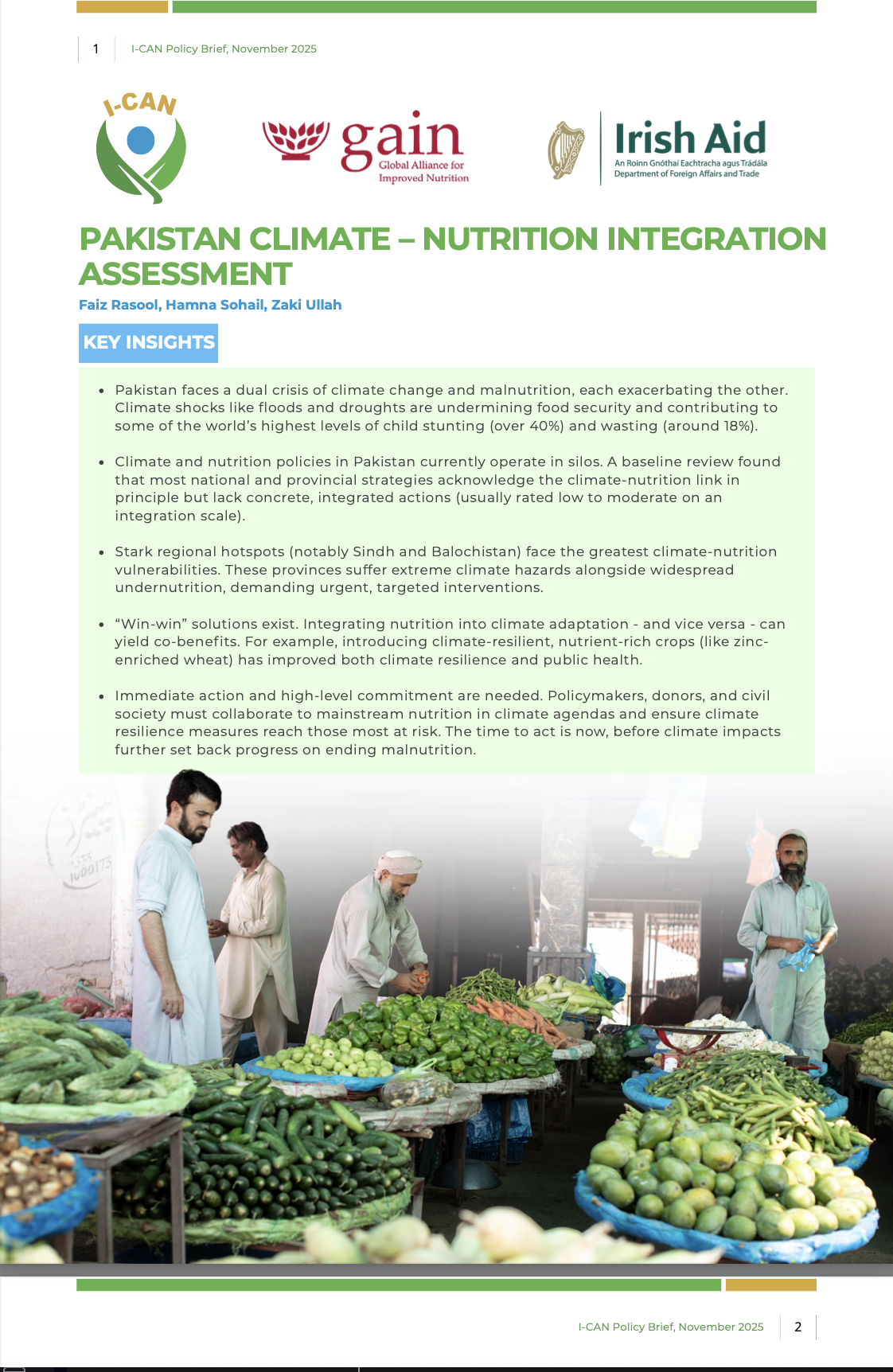
Pakistan is facing a converging crisis of climate change and malnutrition, with floods, droughts, and heat stress undermining food security and nutrition outcomes—particularly for women and children. While national and provincial policies increasingly acknowledge the climate–nutrition link, most lack concrete targets, financing, and coordination mechanisms. Drawing on the I-CAN framework, this policy brief assesses current levels of integration and outlines actionable pathways to move from fragmented policies to coordinated implementation that delivers climate-resilient, nutrition-secure outcomes.
Pakistan faces intersecting climate and malnutrition crises, yet responses remain largely siloed. The I-CAN Baseline Assessment examines how climate and nutrition are integrated across national and provincial policies, programs, and data systems, revealing that while linkages are widely acknowledged, they are rarely translated into targets, financing, or coordinated action. With only one national policy achieving full integration, the report highlights critical gaps and practical entry points to strengthen nutrition-sensitive climate action and protect Pakistan’s most vulnerable communities.
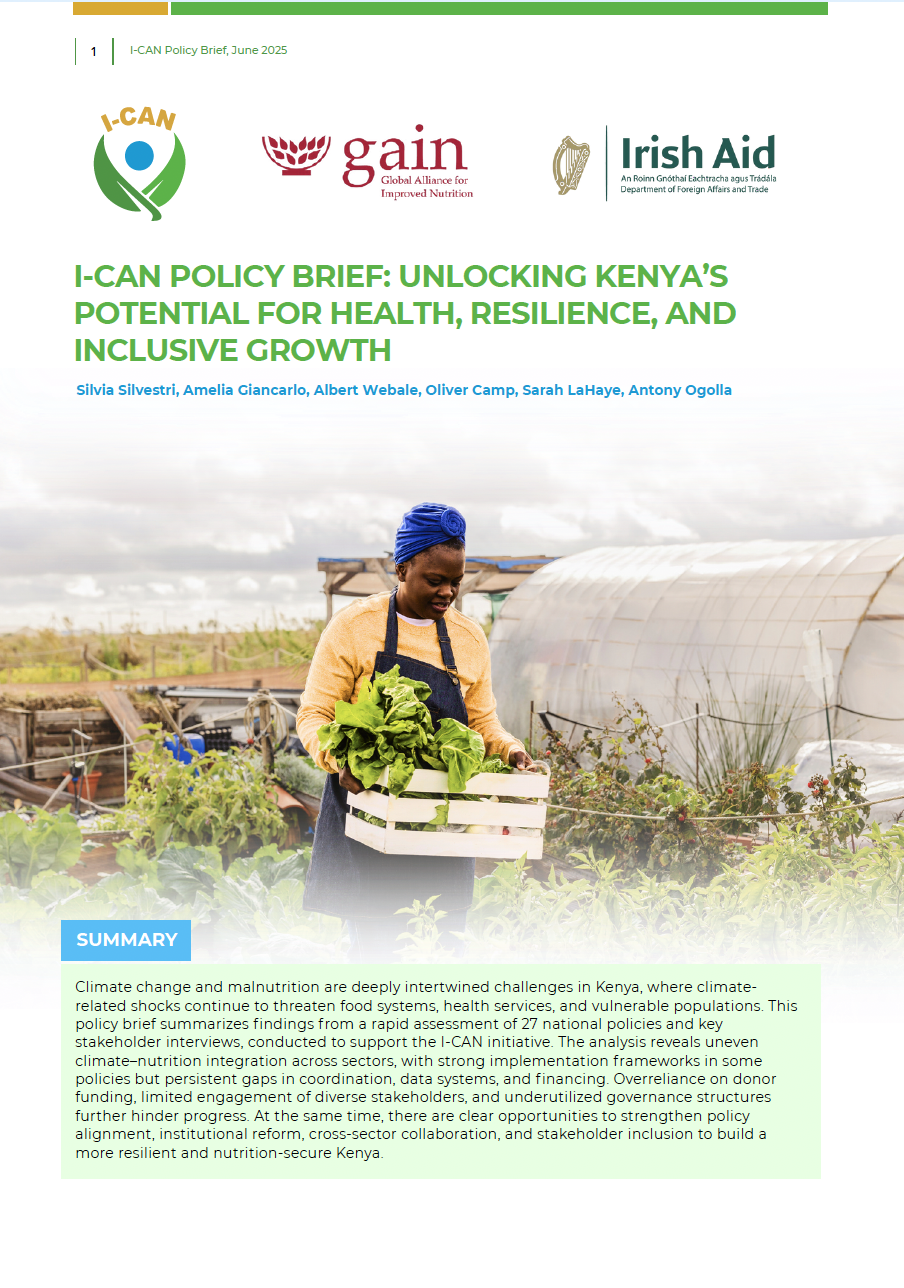
Climate change and malnutrition are deeply intertwined challenges in Kenya, where climate related
shocks continue to threaten food systems, health services, and vulnerable populations. This policy brief summarizes f indings f rom a rapid assessment of 27 national policies and key stakeholder interviews, conducted to support the I-CAN initiative. The analysis reveals uneven climate–nutrition integration across sectors, with strong implementation f rameworks in some policies but persistent gaps in coordination, data systems, and f inancing. Overreliance on donor funding, limited engagement of diverse stakeholders, and underutilized governance structures further hinder progress. At the same time, there are clear opportunities to strengthen policy
alignment, institutional reform, cross-sector collaboration, and stakeholder inclusion to build a more resilient and nutrition-secure Kenya.
This report summarizes key findings from the Kenya policy landscaping and stakeholder mapping analyses and provides recommendations to strengthen policy integration in support of the Initiative on Climate Action and Nutrition (I-CAN).
The analysis reviewed 27 active, inactive, and draft policies across nutrition and health, climate and environment, food systems and agriculture, and general development, classifying each according to the 2023 I-CAN Baseline Report integration framework. Findings were complemented by key informant interviews with 16 stakeholders from government and academia, which also informed the stakeholder mapping by identifying institutional mandates, informal influence, coalition behavior, and cross-sector leverage points.
Pakistan is facing a converging crisis of climate change and malnutrition, with floods, droughts, and heat stress undermining food security and nutrition outcomes—particularly for women and children. While national and provincial policies increasingly acknowledge the climate–nutrition link, most lack concrete targets, financing, and coordination mechanisms. Drawing on the I-CAN framework, this policy brief assesses current levels of integration and outlines actionable pathways to move from fragmented policies to coordinated implementation that delivers climate-resilient, nutrition-secure outcomes.
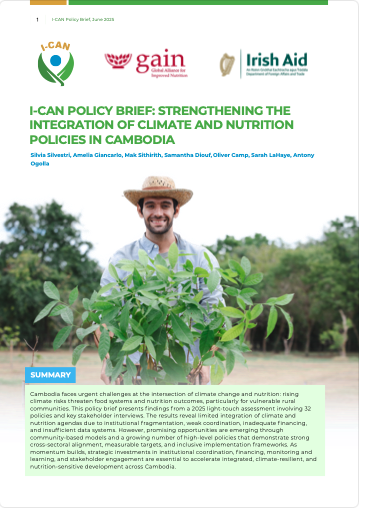
This report summarizes key findings from the policy landscaping and stakeholder mapping analyses in Cambodia and provides recommendations to strengthen policy integration under the Initiative on Climate Action and Nutrition (I-CAN).
The analysis reviewed 32 active, inactive, and draft policies across nutrition and health, climate and environment, food systems and agriculture, and general development, classifying each by its level of climate–nutrition integration using the 2023 I-CAN Baseline Report framework. Findings were complemented by key informant interviews with 15 stakeholders from government and academia, which also informed stakeholder mapping by identifying institutional roles, informal influence, coalition dynamics, and cross-sector leverage points.
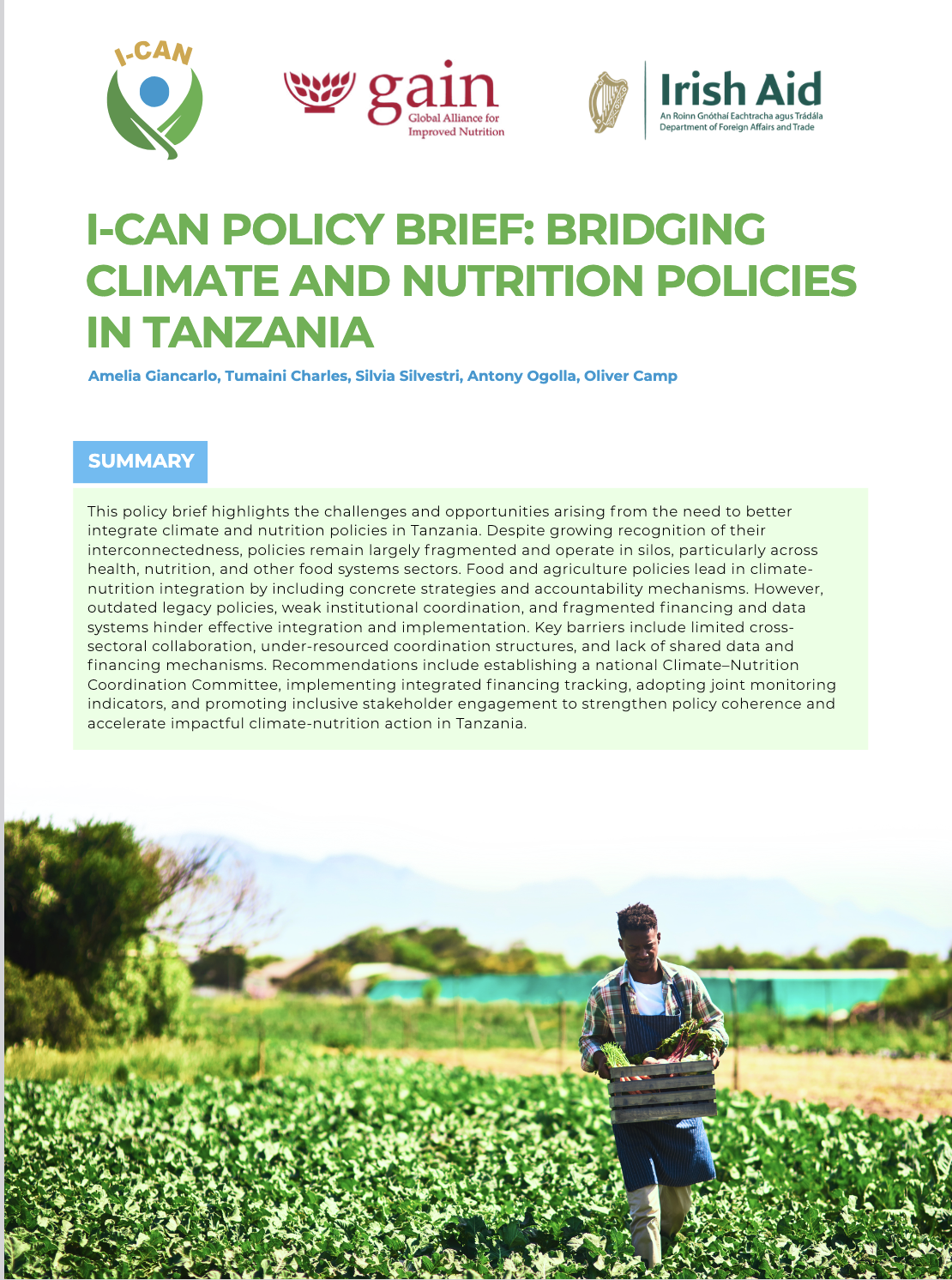
I-CAN Policy Brief, June 2025. This policy brief highlights the challenges and opportunities arising from the need to better integrate climate and nutrition policies in Tanzania. Despite growing recognition of their interconnectedness, policies remain largely fragmented and operate in silos, particularly across health, nutrition, and other food systems sectors. Food and agriculture policies lead in climate-nutrition integration by including concrete strategies and accountability mechanisms. However, outdated legacy policies, weak institutional coordination, and fragmented financing and data systems hinder effective integration and implementation. Key barriers include limited cross-sectoral collaboration, under-resourced coordination structures, and lack of shared data and financing mechanisms. Recommendations include establishing a national Climate–Nutrition Coordination Committee, implementing integrated financing tracking, adopting joint monitoring indicators, and promoting inclusive stakeholder engagement to strengthen policy coherence and accelerate impactful climate-nutrition action in Tanzania.
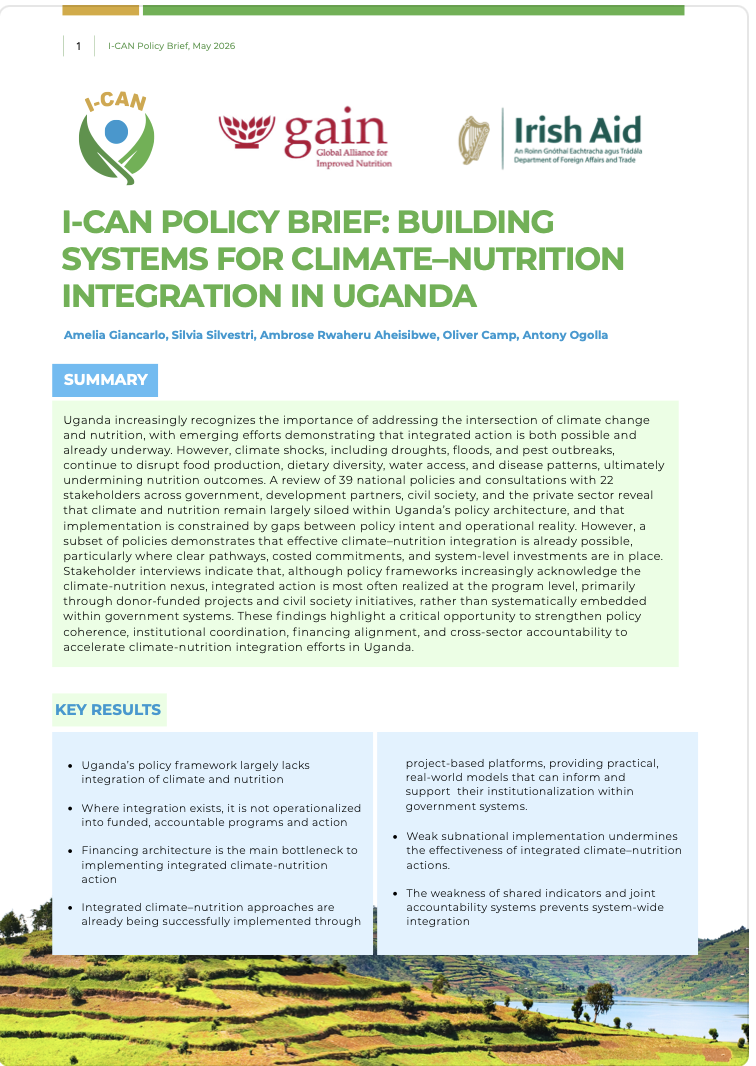
Uganda increasingly recognises the importance of addressing the intersection of climate change and nutrition, with emerging efforts demonstrating that integrated action is both possible and already underway. However, climate shocks, including droughts, floods, and pest outbreaks, continue to disrupt food production, dietary diversity, water access, and disease patterns, ultimately undermining nutrition outcomes.
A review of 39 national policies and consultations with 22 stakeholders across government, development partners, civil society, and the private sector reveal that climate and nutrition remain largely siloed within Uganda’s policy architecture, and that implementation is constrained by gaps between policy intent and operational reality.
Uganda is increasingly recognizing the importance of addressing the intersection of climate change and nutrition, with a growing number of policies and institutional actors engaging with the climate–nutrition nexus. Several policies and initiatives demonstrate that integrated action is both possible and already underway, particularly where explicit pathways, costed commitments, and system-level resilience investments are included. Institutions such as the Office of the Prime Minister, the National Planning Authority, and the Ministry of Health provide important entry points for strengthening coordination, while informal influence networks and policy windows offer additional opportunities to advance integration.
Somalia has a growing policy architecture for climate resilience, food systems, nutrition, health, social protection, and disaster risk management. The I-CAN landscaping analysis finds that this architecture provides a credible foundation for integrated action, but that integration remains uneven and not yet consistently operationalised. The assessment reviewed 38 documents, including 25 policies and strategies, and triangulated the review with stakeholder consultations, Key Informant Interview (KII) responses, and a validation workshop in Mogadishu.
The analysis shows that selected frameworks—especially the Somalia Multi-Sectoral Nutrition Strategy 2026-2030, the Somalia Nutrition Cluster Strategy 2026-2030 and the Health National Adaptation Plan—contain stronger provisions for climate-nutrition integration. However, many climate, food security, agriculture, health, and social protection frameworks only acknowledge the connections between climate change and nutrition—stopping short of taking meaningful action to address both as an integrated agenda.
The I-CAN Landscaping Analysis on Climate and Nutrition Policies and Stakeholders in Somalia provides a comprehensive evaluation of the integration between climate action and nutritional outcomes within the national policy framework.
Supported by the Agrifood Systems Transformation Accelerator (AFST-A), this analysis examines how Somalia—a nation facing concurrent climate shocks and high malnutrition—aligns its strategic objectives to build systemic resilience.
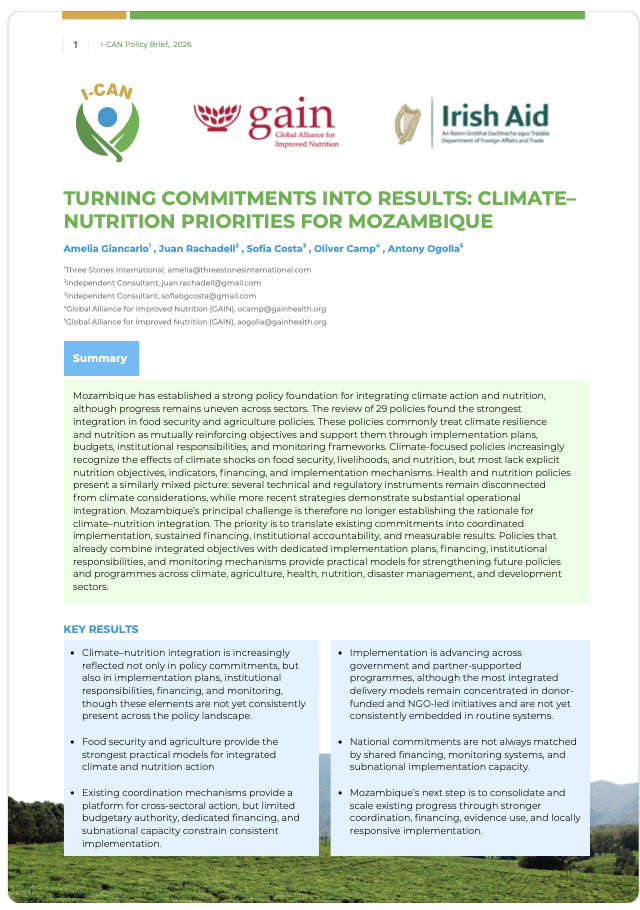
Mozambique has established a strong policy foundation for integrating climate action and nutrition, although progress remains uneven across sectors. The review of 29 policies found the strongest integration in food security and agriculture policies.
These policies commonly treat climate resilience and nutrition as mutually reinforcing objectives and support them through implementation plans, budgets, institutional responsibilities, and monitoring frameworks.
Mozambique faces interconnected climate and nutrition challenges. Recurrent droughts, floods, cyclones, and extreme rainfall disrupt agricultural production, livelihoods, markets, water and sanitation systems, and health services, with important consequences for food security and nutrition.
These hazards are particularly significant because many households depend on climate sensitive agriculture for food and income. This assessment examines how Mozambique’s national policies and institutional landscape frame the connection between climate and nutrition .
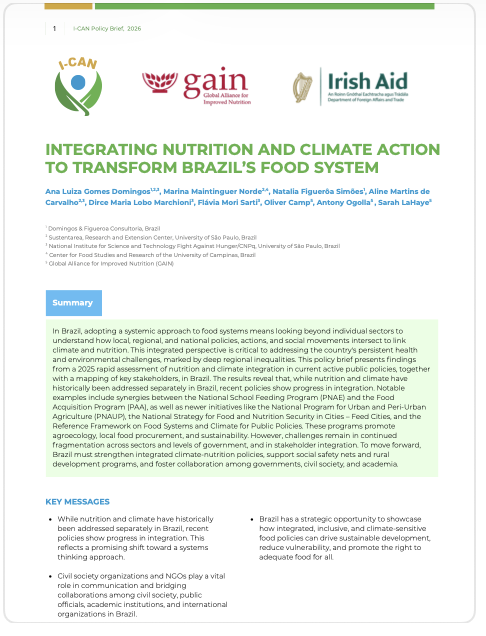
This policy brief presents findings from a 2025 rapid assessment of how nutrition and climate priorities are integrated in Brazil’s public policies and stakeholder landscape. It finds that, although the two agendas have traditionally been addressed separately, recent policies show growing convergence.
Examples include stronger links between the National School Feeding Program (PNAE) and Food Acquisition Program (PAA), alongside newer initiatives on urban agriculture, food and nutrition security in cities, and food systems and climate policy. The brief highlights the importance of a systemic approach that connects policies and actors across levels to address Brazil’s health, environmental and regional inequality challenges.
I-CAN, launched at COP27 in 2022, aims to accelerate action linking climate change and nutrition. Its 2023 baseline found that few countries fully integrate nutrition and climate priorities, with progress strongest in Latin America, the Caribbean and Africa, but investment still lagging.
In Brazil, tackling obesity, undernutrition and climate change together requires integrated food systems action that supports healthy sustainable diets, protects ecosystems and promotes fair livelihoods.

Environment and Food Systems Advocacy Advisor

Project Manager for the Initiative on Climate Action and Nutrition (I-CAN)