Track A
Biology, Data and Efficacy of Interventions
How to harness new science and technology innovations to ensure progress in nutrition in a rapidly changing world.
GAIN at MNF 2026
GAIN will contribute evidence, share practical learning from programmes and partnerships, and advance discussion on how food systems, healthier diets and micronutrient action can reinforce one another in a changing world.
2026 Conference Theme
Exploring evidence, policy and innovation across nutrition, food systems, climate and development.
About the conference
The world is confronting interconnected challenges that shape nutrition outcomes, including climate change, food systems disruption, mounting financing pressures, conflict and displacement.
Against this backdrop, the Micronutrient Forum’s 7th Global Conference brings together the global nutrition community in Accra, Ghana and online from 28 September to 1 October 2026.
Under the theme “Nutrition at the Frontiers of a Changing Environment,” the conference will explore evidence, policy and innovation across nutrition, food systems, climate and development, with a strong emphasis on equity, shared learning and leadership from Africa and other low- and middle-income countries.
The MNF 2026 seeks to build knowledge, strengthen advocacy, and sustain nutrition progress in a rapidly changing world. Through emerging technologies, advanced data, new financing models, cross-sector partnerships, and more, MNF 2026 will create space to examine how nutrition action can remain effective, equitable, and resilient. The conference will pursue its objectives by exploring nutrition at the frontiers of a changing global environment across three tracks focused on resilience, innovation, and collaboration to sustain progress at scale.
Conference tracks
The conference tracks are framed around advancing nutrition in a rapidly changing global context, with a focus on science and technology, climate and conflict realities, financing, partnerships and leadership.
Track A
How to harness new science and technology innovations to ensure progress in nutrition in a rapidly changing world.
Track B
How to ensure progress in nutrition in a new reality of climate change, funding cuts, conflicts and disruption.
Track C
How new models of financing, integration, collaboration and leadership can enable countries to support nutrition programmes and make agriculture, climate and health investments more nutrition-smart.
For more on the MNF 2026 conference and registration, please visit:
GAIN at MNF 2026
Through participation in the MNF conference GAIN aims to contribute evidence, share practical learning from programmes and partnerships, and advance discussion on how food systems, healthier diets, and micronutrient action can reinforce one another in a changing world.
GAIN will participate in MNF 2026 through technical sessions, panel discussions, oral and poster presentations, and selected side events. Our contributions will reflect GAIN’s programme portfolio and cross-cutting priorities, including healthier diets, food systems transformation, resilience, data and evidence, and partnership models that improve nutrition outcomes at scale.
Poster presentations
GAIN poster and rapid fire oral presentation contributions. (Scroll to view more)
1
Lead author: Roberta Bove
2
Lead author: Dr. Julia Boedecker
3
Lead author: Svenja Jungjohann
4
Lead author: Dr. Julia Boedecker
5
Lead author: Annette Mongina Nyangaresi
6
Lead author: Svenja Jungjohann
7
Lead author: Annette Mongina Nyangaresi
8
Lead author: Svenja Jungjohann
9
Lead author: Svenja Jungjohann
10
Lead author: Florencia Vasta
11
Lead author: Siamola Murundo
12
Lead author: Joshua Chibuyi
13
Lead author: Kris Woltering
14
Lead author: Kris Woltering
15
Lead author: Olutayo Adeyemi
16
Lead author: Sowrya Kilaru
17
Lead author: Sowrya Kilaru
18
Lead author: Sowrya Kilaru
19
Lead author: Annette Mongina Nyangaresi
20
Lead author: Marie Krottenthaler
21
Lead author: Gloria Njoku-Franklin
22
Lead author: MD Abul Bashar Chowdhury
23
Lead author: Aubierge Flenon
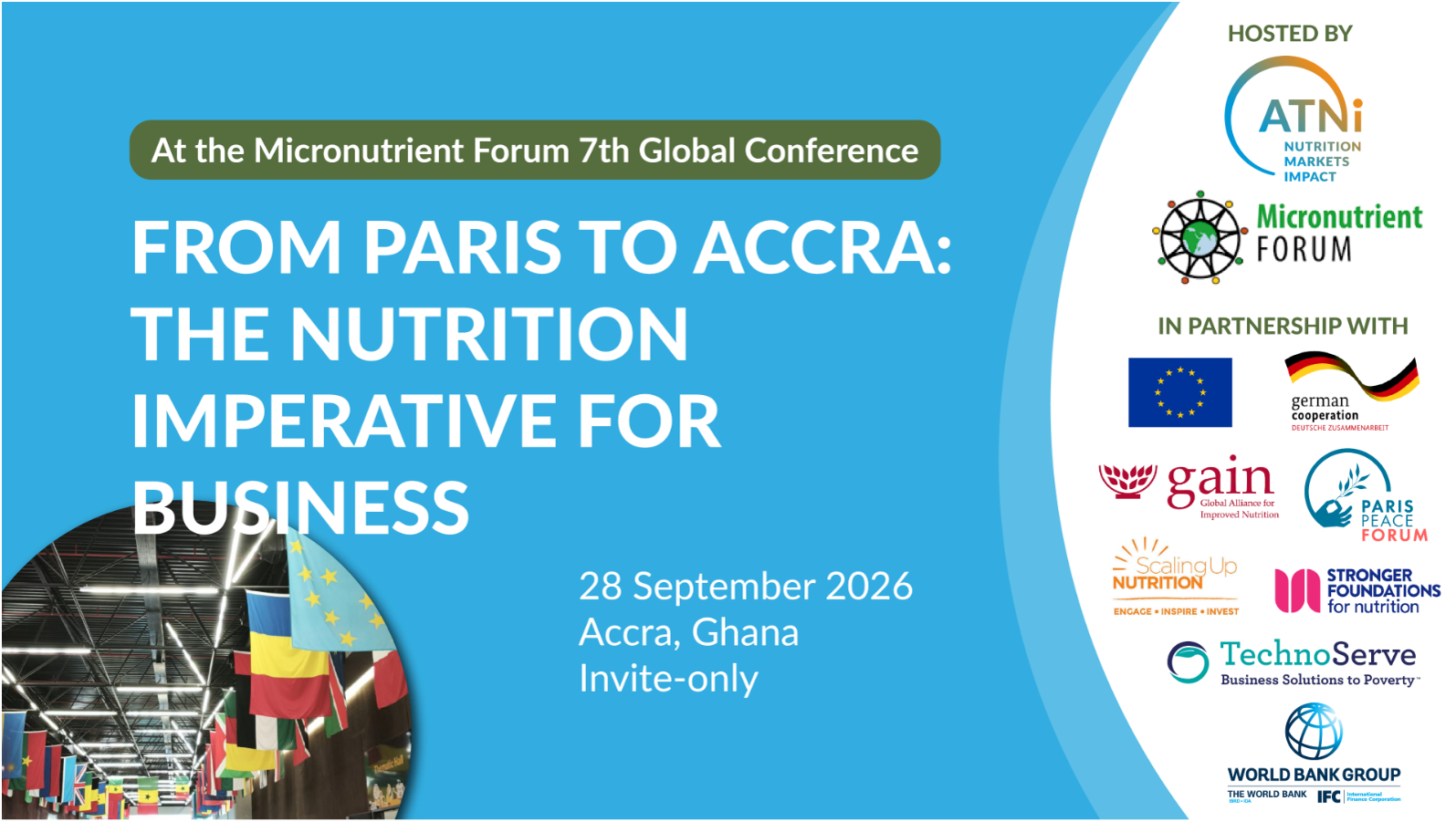 Invite-only side event
 Featured side event
28 September 2026
Bringing together government, business, investors, donors, civil society and international organisations to explore practical action and investment for better nutrition.
Led by GAIN in collaboration with FAO, with IDS as a partner
This 90-minute Micronutrient Forum 2026 symposium, led by GAIN in collaboration with FAO, with IDS as a partner, builds on the 2024 paper “Food Systems Interventions for Nutrition: Lessons from 6 Program Evaluations in Africa and South Asia.”
That work identified five recurring challenges in evaluating complex food systems programmes: weak evidence underpinning intervention design; dynamic and multifaceted programmes; difficulty establishing attribution; limited or untimely access to data, particularly from private-sector actors; and defining appropriate outcomes across long and complex causal pathways.
The symposium asks a practical question: what has happened since? Rather than simply revisiting the theory, presenters use recent evaluations to demonstrate how they encountered one or two of these methodological challenges, what approaches they used to address them, what worked, what trade-offs emerged, and what remains unresolved. The overall aim is to build a shared picture of methodological progress and remaining gaps in food systems evaluation.
The cases bring different perspectives and contexts. Valerie Flax of GAIN draws on evaluations of market-based approaches in Kenya and Mozambique; Inka Barnett of IDS explores evaluating systems change in food culture alliances and moving beyond attribution towards contribution and learning; Claire Null of FAO provides an FAO evaluation perspective; and Silvia Alonso examines market interventions for food safety and nutrition through the MoreMilk project in Kenya.
The symposium is structured around a short framing by the Chair, followed by the four presentations and a substantial facilitated discussion/Q&A with all panellists. The discussion moves beyond individual evaluations to ask what remains unresolved, what evaluators would do differently, where the field has progressed since 2024, which methodological innovations or collaborations should now be prioritised, and whether evaluation approaches are producing the evidence that policymakers and donors actually need.
The intended outcome is therefore not simply to showcase evaluation findings, but to generate practical learning for the field. Participants should leave better able to understand the methodological challenges inherent in evaluating complex food systems interventions, recognise approaches being used to navigate them, interpret emerging evidence from LMIC settings, and identify priorities for methodological innovation and cross-institutional collaboration.
Related publication
GAIN at MNF 2026
GAIN team members will participate in MNF 2026 through technical sessions, panel discussions, oral and poster presentations, and selected side events, contributing evidence and practical learning from programmes and partnerships.

Director, Knowledge Leadership

Chief Technical Officer

Policy & Influencing Manager, GAIN Mozambique and Senior Policy Advisor, Food Systems Summit 2021

Research Lead, Food Environments and Supply Chains

Senior Lead, Innovative Finance for Nutrition

Lead, Social Protection

Project manager – Biofortification

Programme Lead, Large Scale Food Fortification

Associate, Programme Monitoring and Improvement

Senior Advocacy Specialist

Senior Technical Specialist-Knowledge Leadership

Project Manager and Lead – Workforce Nutrition and Fresh Market, GAIN Bangladesh

Program Monitoring and Improvement Advisor, GAIN

Project Manager, CASCADE Benin and SUN Business Network

Technical Specialist (LSFF, Biofortification and Food Safety), Knowledge Leadership

Senior Technical Specialist, Knowledge Leadership

Senior Associate, Global Advocacy (Large Scale Food Fortification)