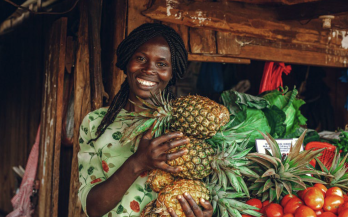
- 15/10/2025
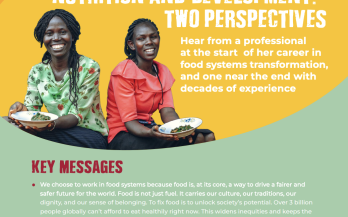
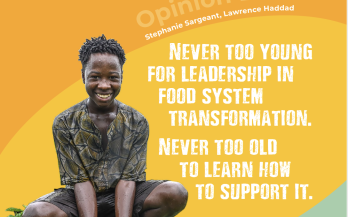
Hear from a professional at the start of her career in food systems transformation, and one near the end with decades of experience
Key Messages
• We choose to work in food systems because food is, at its core, a way to drive a fairer and
safer future for the world. Food is not just fuel. It carries our culture, our traditions, our
dignity, and our sense of belonging. To fix food is to unlock society’s potential. Over 3 billion
people globally can’t afford to eat healthily right now. This widens inequities and keeps the
vulnerable trapped in cycles of poor health.
• Food systems transformation touches every aspect of our lives and cannot be achieved in
isolation. It spans agriculture, health, trade, finance, education, environment, and social
protection, and it relies on people all along the supply chain, from farmers and traders to
processors, retailers, policymakers, and consumers. Few other areas of work demand such
breadth. That is why transforming food systems requires collaboration across sectors
directly and indirectly linked to food, and why it offers opportunities for people with
different skills, perspectives, and passions to contribute.
• The 2025 World Food Day theme calls for greater collaboration across sectors and silos to
transform agrifood systems for people and planet. This is a huge part of the work that
must be done, and we remain hopeful that solidarity and compassion will win over more
selfish politics. At GAIN we work hard to bring disparate voices across the food system
together, for real transformation.
- 11/10/2025
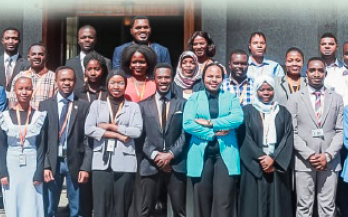
Youth in Tanzania are active at the community level but remain largely absent from formal
governance. There is potential for Tanzanian youth to more actively help Tanzania in its ambition to
achieve a nutrition-sensitive, climate resilient, inclusive food system.
- 11/10/2025
KEY MESSAGES
Children in both urban and rural Ethiopia are increasingly consuming ultra-processed foods that contain unhealthy levels of sugar, salt, and unhealthy fats. These items, heavily marketed and widely accessible, are rapidly replacing traditional healthy diets.
Inadequate and unhealthy diets during childhood can compromise physical and cognitive development, diminish immune function, and increase susceptibility to chronic illnesses later in life.
Priority policy areas the government should consider include: more nutrition education; improved regulation of the food environment to make healthy options more prominent and unhealthy options less prominent; subsidies that prioritize healthy diets for children; and improved coordination and coherence across sectors seeking to transform food systems (e.g. Agriculture, Education, Health, and Trade).
Reducing unhealthy diets in children is not just a nutrition issue – it’s a systems issue. Ethiopia must urgently implement a coordinated, multi-sectoral strategy with actions to ensure all children have access to diverse, healthy, safe, and affordable diets from the start of life.
- 08/09/2025
Stunting is a major concern in Eastern Africa, where nearly 1 in 3 children under 5, about 22.6 million, are
affected (UNICEF, WHO, Worldbank, 2023). In Kenya, the prevalence has declined to approximately one in
five children (18%), outperforming the regional average of 31.6%. However, this still represents more than
1.2 million children at risk (KNBS, Ministry of Health, ICF, 2023). The consequences are far-reaching;
stunting contributes to child mortality, vulnerability, and lifelong impairments in physical growth and
cognitive development, impacting both individual well-being and national productivity. In Kenya, child
undernutrition, including stunting as a key component, is estimated to cost the economy KES 374 billion
(approximately USD 4.2 billion) annually, equivalent to 6.9% of the GDP (Government of Kenya, 2019).
Stunting, a persistent form of long-term nutritional deprivation, acts as a silent driver of inequality, limiting
opportunities, lowering future earnings and reducing the potential to contribute equally to the economy.
Yet the returns on investment in nutrition are high, with every dollar yielding up to $22 in economic
benefit. (Eberwein, et al., 2016)
- 24/09/2025
Food policy has been an active area in the UK throughout 2025. Three of four UK nations having recently published food strategies and plans, with another in preparation, all within a changing geopolitical context. Against this backdrop, this working paper highlights key gaps and potential actions for fostering coherence within food strategies and governments in the UK based on an analysis of UK food strategies using a new tool, the Food Systems Policy Coherence (FSPC) Diagnostic tool. This tool, composed of two modules, aims to provide a simplified and standardised approach to measure policy coherence.
- 29/08/2025
Zambia has demonstrated strong political commitment to food systems transformation while grappling with persistent systemic vulnerabilities that threaten progress toward sustainable food and nutrition security.
As a landlocked country in southern Africa with a population largely dependent on climatesensitive smallholder agriculture, Zambia faces the urgent imperative to build resilience while addressing deep-rooted challenges of malnutrition, poverty, and environmental degradation.
- 28/08/2025
The Countdown then undertook a consultative process to select a set of 50 indicators across these themes, which constitutes the global indicator framework. The Countdown publishes annual monitoring updates and additional analysis to support the transformation of food systems so they become equitable, sustainable, and resilient and positively contribute to achieving the 2030 SDGs and other global goals.
- 26/08/2025
We know in our bones that youth must be part of the solution to the key crises facing
our planet – but why and how exactly? Here we provide government policymakers,
business people, civil society members and development partners in the food systems
space with some ways to advance meaningful youth engagement.
- 15/08/2025
Rwanda faces persistent challenges with malnutrition, and there is increasing interest in the country in taking a food systems approach to tackling it. However, getting this new approach into the development and agricultural sector’s agendas requires understanding the landscape of actors involved. In response, the Ministry of Agriculture and Animal Resources and the Global Alliance for Improved Nutrition commissioned an analytical mapping of actors involved in nutrition and the food system in Rwanda, which was implemented by the Swiss Tropical and Public Health Institute. This was accomplished by conducting a stakeholder mapping at district and national levels through key informant interviews and Net-Map analysis as well as a policy landscape analysis.
- 25/07/2025
Kenya’s engagement in food systems transformation reflects a strong policy commitment and growing political will to address persistent food and nutrition security challenges. This ambition is evident in progressive national frameworks such as the National Food and Nutrition Security Policy (2011), Agricultural Sector Transformation and Growth Strategy (2019–2029), Agricultural Soils Management Policy (2023), and the newly launched National Agroecology Strategy for Food System Transformation (2024–2033).
These strategies are aligned with global and regional commitments, including the Sustainable Development Goals (SDGs), the Paris Agreement on climate change mitigation, and the Malabo Declaration on comprehensive African agricultural development, signalling Kenya’s intention to lead in advancing climateresilient and equitable food systems.