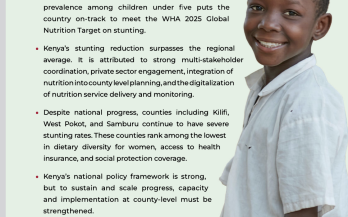
Stunting is a major concern in Eastern Africa, where nearly 1 in 3 children under 5, about 22.6 million, are
affected (UNICEF, WHO, Worldbank, 2023). In Kenya, the prevalence has declined to approximately one in
five children (18%), outperforming the regional average of 31.6%. However, this still represents more than
1.2 million children at risk (KNBS, Ministry of Health, ICF, 2023). The consequences are far-reaching;
stunting contributes to child mortality, vulnerability, and lifelong impairments in physical growth and
cognitive development, impacting both individual well-being and national productivity. In Kenya, child
undernutrition, including stunting as a key component, is estimated to cost the economy KES 374 billion
(approximately USD 4.2 billion) annually, equivalent to 6.9% of the GDP (Government of Kenya, 2019).
Stunting, a persistent form of long-term nutritional deprivation, acts as a silent driver of inequality, limiting
opportunities, lowering future earnings and reducing the potential to contribute equally to the economy.
Yet the returns on investment in nutrition are high, with every dollar yielding up to $22 in economic
benefit. (Eberwein, et al., 2016)
Food policy has been an active area in the UK throughout 2025. Three of four UK nations having recently published food strategies and plans, with another in preparation, all within a changing geopolitical context. Against this backdrop, this working paper highlights key gaps and potential actions for fostering coherence within food strategies and governments in the UK based on an analysis of UK food strategies using a new tool, the Food Systems Policy Coherence (FSPC) Diagnostic tool. This tool, composed of two modules, aims to provide a simplified and standardised approach to measure policy coherence.
Stockholm Food Forum: Engage. Act. Transform.
The Stockholm Food Forum, convened by EAT, is a carefully curated event open to up to 700 participants by invitation only. This results in a gathering of global thought leaders from science, politics, business, civil society and beyond.
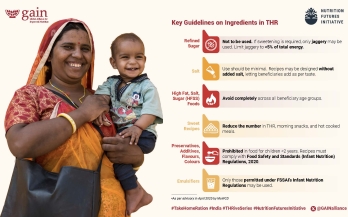
The Take-Home Ration (THR) component of India’s Supplementary Nutrition Programme, the world’s largest
flagship supplementary feeding programme under POSHAN 2.0 and Saksham Anganwadi, is a key intervention to improve the nutrition of children 6-36 months, adolescent girls, pregnant women, lactating mothers. THR has evolved over the years to ensure it provides adequate amount of daily and protein for children and PWLMs, with recent updates emphasizing macro- and micronutrient profiles and limiting added sugars, salt, preservatives, and synthetic additives.
Ethiopia faces persistent malnutrition and emerging diet-related challenges. Nutrition for Growth (N4G), a pledging movement in which the world’s leaders have committed to centre nutrition, offers a platform to mobilize multisectoral action and accountability. GAIN offers technical expertise in food systems and nutrition governance, to support Ethiopia translate its national strategies in its goal of supporting the Government of Ethiopia (GoE) in accelerating its progress towards Food System Transformation.
Pemba, Mozambique – From the window of his house in Quissanga district, Cabo Delgado, Andrade Vitorino watched helplessly as his poultry farm collapsed due to strong winds and rains caused by cyclone Kenneth in 2019.
But since the 2017, it is the armed conflict in Cabo Delgado province that affected his business and various economic activities, as well as the functioning of food systems in the province.
“One day, a neighbour shouted that we were under attack, and we all ran away, leaving everything behind. A few days later I heard that everything had been burned down. Houses and everything, including my poultry,” said Andrade.
Seated on a plastic chair and turning his back to his house made of clay, in one of Pemba's neighbourhoods, where he is starting new life he says, “I didn't have time to take anything. Just my documents. My house, my aviary and my dreams were left behind.”
GAIN Tanzania is at the forefront of efforts to tackle micronutrient deficiencies through biofortification, an approach that enhances the nutritional content of staple crops. One of its most impactful initiatives has focused on high iron beans (HIB), a locally accepted, nutrient-rich variety introduced through partnerships with schools and farming communities. By connecting farmers to institutional markets and supporting local seed systems, GAIN is creating a sustainable, scalable model for improving diets and livelihoods. In this interview, Prisca Kokutona Rwezahura, Country Director -GAIN Tanzania, reflects on this journey- sharing insights into policy, partnerships, and what’s next for biofortification in the country.