- 11/09/2025
While Rwanda has made notable progress in recent decades on areas linked to improved prosperity such as growth in agricultural production and poverty reduction,rates of malnutrition remain a public health concern, particularly among vulnerable groups like young children.
- 15/08/2025
Rwanda faces persistent challenges with malnutrition, and there is increasing interest in the country in taking a food systems approach to tackling it. However, getting this new approach into the development and agricultural sector’s agendas requires understanding the landscape of actors involved. In response, the Ministry of Agriculture and Animal Resources and the Global Alliance for Improved Nutrition commissioned an analytical mapping of actors involved in nutrition and the food system in Rwanda, which was implemented by the Swiss Tropical and Public Health Institute. This was accomplished by conducting a stakeholder mapping at district and national levels through key informant interviews and Net-Map analysis as well as a policy landscape analysis.
- 16/05/2025
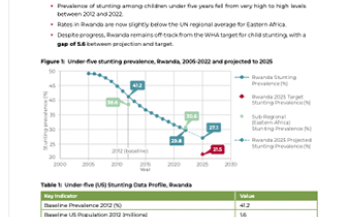
WHA Global Nutrition Stunting Target 2012-2025
Achieve a 40% reduction in the number of children under-5 who are stunted
WHA Global Nutrition Overweight Target 2012-2025
Ensure that there is no increase in childhood overweight
- 07/11/2024
A diverse diet is important for health and well-being, contributing to lower malnutrition, including micronutrient deficiency diseases (hidden hunger), as well as underweight, overweight, and associated ill health like low immune system function and non-communicable diseases. It is highlighted under Rwanda’s draft Strategic Plan for Agricultural Transformation (PSTA-5) (2024 to 2030).
- 04/11/2021
GAIN has long supported SMEs to increase their production of safe and nutritious foods but has found it difficult to understand the impact of such activities on consumers. As food is a fast-moving consumer good, which travels in large volumes between diverse actors of a value chain, spanning wide areas, it can be hard to identify its end consumers, and collecting data from them can be resource intensive.
- 06/06/2021
The COVID-19 pandemic is a multiplier of vulnerability, compounding threats to food security and nutrition (FSN) while exposing weaknesses in food systems. In response, the Global Alliance for Improved Nutrition (GAIN) developed the Keeping Food Markets Working (KFMW) programme to provide targeted support to help sustain core food systems.
- 07/04/2021
GAIN and partners, including the Scaling Up Nutrition (SUN) Business Network (co-convened by the World Food Programme (WFP)), undertook a survey of food system SMEs in Rwanda in October/November 2020, aiming to assess the impacts of the COVID-19 pandemic and associated control measures on their businesses and their support needs.
- 18/03/2021
This Situation Report—the fifth in a series—finds that COVID-19-related control measures continue to have an impact on food systems in 10 countries where GAIN works: Bangladesh, Ethiopia, India, Indonesia, Kenya, Mozambique, Nigeria, Pakistan, Rwanda and Tanzania.
- 02/12/2020
The COVID-19 pandemic is a multiplier of vulnerability, compounding threats to food security and nutrition (FSN), while exposing weaknesses in food systems. In response, the Global Alliance for Improved Nutrition (GAIN) developed the Keeping Food Markets Working (KFMW) programme to provide targeted support to help sustain core food systems, workers, and markets during the COVID-19 emergency.
- 09/10/2020
Although eggs are highly nutritious, they remain scarce and relatively expensive in many low-income settings, including across many of the countries where GAIN operates. Moreover, they are only rarely consumed by children in many regions. Globally, the average egg supply is around 3.5 eggs per person per week.