
Dr. Garima Singh
Project Coordinator, Food Systems Dashboard and Food Fortification portfolios
India’s food systems are as diverse as its geography and cultures, and what people grow, access, and consume varies considerably across the country. India has made significant progress in agricultural production and food security; India’s foodgrain production has reached a record high of 376.56 million tonnes1, an increase of about 5.3% over the previous year. Yet challenges related to malnutrition, healthy diet affordability, environmental sustainability, and climate resilience persist.
India continues to face significant food and nutrition challenges despite improvements in child nutrition. According to the Ministry of Health and Family Welfare’s National Family Health Survey (NFHS-6, 2023–24), 19.0% of children under five are wasted, 29.3% are stunted and 31.8% are underweight. Meanwhile, the Ministry of Statistics and Programme Implementation’s Consumer Price Index reported 5.95% year-on-year food inflation in August 2026, highlighting continuing pressures on household food affordability. Household consumption expenditure data also provide insights into food spending patterns and differences in consumption across rural and urban India.
Addressing these challenges is obviously multipronged, a key element of which is data. However, it is not simply a matter of collecting more data. Considerable information already exists across government surveys, administrative databases, and research institutions. However, it is largely organised by sector, which makes it hard to see how agricultural production, food environments, diets, nutrition, and environmental sustainability connect.
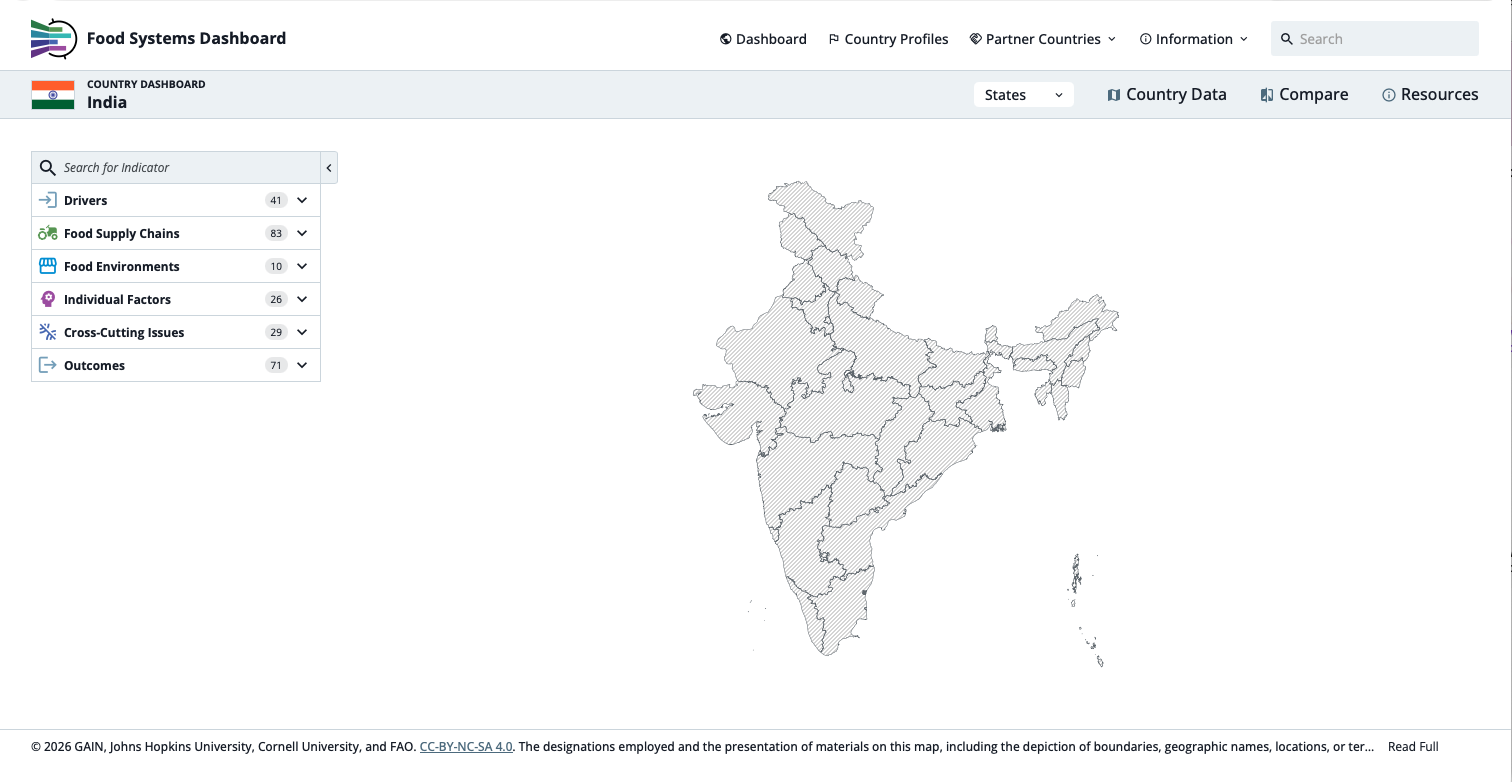
To bridge this gap, the Global Alliance for Improved Nutrition (GAIN), has developed the India Food Systems Dashboard . This publicly accessible platform brings more than 260 existing indicators together within an integrated food systems framework. It covers national-level, state-level and selected district-level data. Its value lies not in generating new statistics but in connecting evidence across sectors and administrative levels. This helps policymakers examine challenges from several angles, identify geographical disparities, and ask more informed questions about policy responses, moving discussions from isolated indicators towards a fuller understanding of food systems.
Punjab and Kerala sit at opposite ends of India’s food production spectrum. Punjab is the country’s surplus producer. The FSD shows that all its net sown area is irrigated (2023–24), its foodgrain yield reached 4,761 kg per hectare in 2024–25, and its per capita milk availability, at 1,245 grams a day, is the highest of any state. On the other hand, Kerala grows far less of its own food. About a fifth of its net sown area is irrigated, its foodgrain yield is 2,906 kg per hectare, and milk availability is 197 grams per person a day.
Yet the latest NFHS data show almost identical child stunting: 20.1% in Kerala and 20.4% in Punjab (2023–24). The differences lie in diet quality and micronutrient status. In Kerala, 26% of children aged 6–23 months receive an adequate diet, more than double Punjab’s 11.1%. Monthly rural fruit consumption is about three times higher in Kerala (6.2 kg against 2.0 kg in 2022–23). Anaemia among women aged 15–49, last reported for 2019–21, stood at 58.7% in Punjab compared with 36.3% in Kerala. Both states also share an emerging challenge: close to half of women are overweight or obese (46.7% in Kerala, 44.7% in Punjab).
Abundant production, then, does not by itself lead to diverse diets or better nutrition. A state that relies on food from elsewhere can achieve comparable outcomes through markets, incomes, and strong health and social services. The data also point to different priorities. For Punjab, they are diversifying diets and production beyond cereals and dairy, and tackling anaemia. For Kerala, they are sustaining dietary diversity while responding to rising overweight.
Food systems policies must therefore respond to local realities rather than assume one approach works everywhere.
As India moves towards the Government’s vision of Viksit Bharat 2047, our food systems have a powerful role to play in building a healthier, more prosperous nation. Much of that progress will be shaped on our farms, in our markets and on our plates.
Punjab and Kerala example remind us that there is no single road to that future. Each state starts from a different place and will need its own strategies. This is where the India FSD can make a real difference. It lets states set their own milestones, check how far they have come, and learn from each other.
In the end, the dashboard’s real value is not the numbers it holds rather the better decisions those numbers can lead to. If we use it well, the road to a developed India will also be the road to a well-nourished one.
For more details: Please visit the India Food Systems Dashboard .
Ministry of Agriculture & Farmers Welfare, Government of India. Third Advance Estimates 2025–26. May 2026.
Project Coordinator, Food Systems Dashboard and Food Fortification portfolios