
Dr. Supreet Kaur
Senior Policy Advisor
Summary: India’s agricultural transformation is widely recognised as one of the most consequential development stories of the twentieth century.
India’s agricultural transformation is widely recognised as one of the most consequential development stories of the twentieth century. From chronic food shortages in the decades following independence to self-sufficiency in staple cereals like rice wheat and millets, India’s investments in irrigation, research, and price support fundamentally reshaped food availability. Public procurement and subsidised public distribution systems ensured that calories reached even the most vulnerable. And this culminated in the institutionalisation of food security through the National Food Security Act.
Despite these achievements, India today faces a paradox that is increasingly difficult to ignore high levels of child stunting and anaemia coexist with rising overweight, obesity, and diet related non communicable diseases. NFHS-6 (2023–24) highlights a mixed nutrition landscape in India. While notable progress from NFHS 5 to 6 has been achieved in reducing child stunting (from 35.5% to 32.3%), wasting (19.3% to 16.3%), and underweight prevalence (32.1% to 29.2%), nearly one in three children remains undernourished and wasting continues to affect about one in five children. Simultaneously, rising levels of overweight, obesity, and other diet-related non-communicable diseases underscore the growing challenge of the burden of malnutrition. These data points highlight India’s paradoxical public-health crisis, while stressing the urgent need to intentionally place a key element at the centre of its Agricultural Transformation – Nutrition.
India’s development pathway desperately and intentionally needs nutrition at the centre of its agricultural transformation. This will not only unlock greater gains for health, livelihoods, and resilience, but also for its economic growth. Every dollar invested in nutrition yields $23 in economic returns.
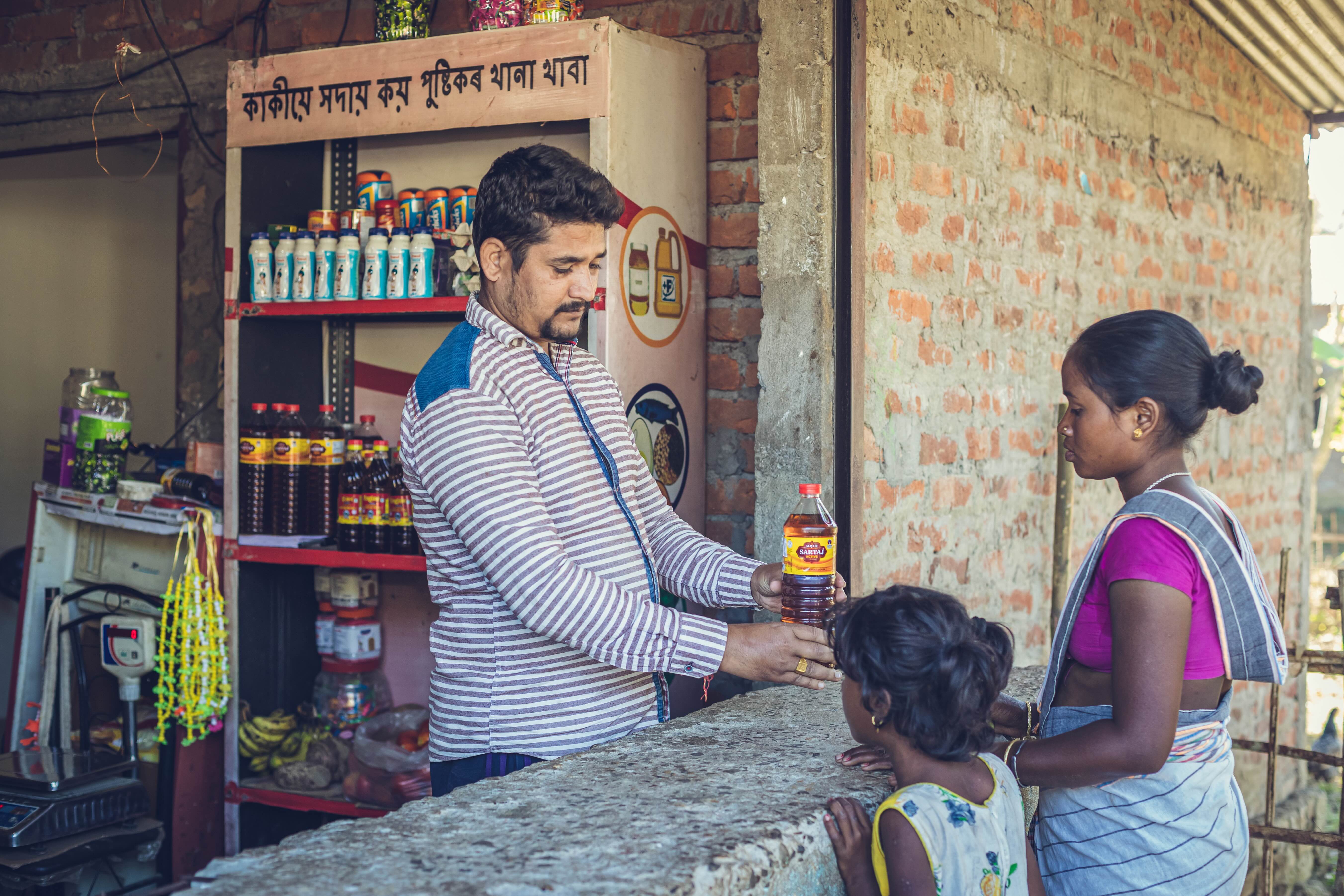
A central challenge is that while India’s agricultural transformation has substantially improved food security, nutrition has often been treated as an assumed outcome rather than an explicit objective. Bridging this gap requires a food systems approach that places nutrition at its core by promoting dietary diversity, improving the affordability of healthy diets, and strengthening efficient and inclusive markets. This must be supported by integrated data systems that link agricultural production, food environments, and nutrition outcomes, enabling evidence-based decision-making and ensuring that gains in agricultural output translate into improved nutrition security.
Food systems encompass the full range of actors and activities involved in producing, processing, distributing, preparing, and consuming food. In India, the key components of the food system from smallholder production and informal aggregation to processing, retail, and consumption are deeply interconnected but unevenly supported. Food systems are shaped by multiple drivers, including policies and public investments, market incentives, technology, climate variability, cultural norms, gender roles, and consumer preferences. Understanding these drivers is critical because they explain why increased agricultural output has not translated into improved diet quality for large segments of the population.
India’s food system has historically prioritised staple cereals, supported by minimum support prices, assured procurement, and public distribution. While this architecture has been instrumental in addressing hunger, it has also narrowed production incentives and crowded out diversification. At the same time, downstream segments of the food system storage, cold chains, processing, logistics, and retail have remained fragmented and underdeveloped, particularly for perishable, nutrient rich foods such as indigenous foods, fruits, vegetables, pulses, eggs, and dairy. The result is a system where nutritious foods are often physically available but economically inaccessible, especially for low-income households. The imbalance helps explain India’s persistent paradox of abundant food and poor diets.
Strengthening India’s food systems begins with reorienting policy incentives to support diet diversity. Production diversification towards pulses, millets, fruits and vegetables must be enabled through coherent support across procurement, research, extension, and risk management. Recent policy shifts, including the promotion of millets and the integration of nutrition goals into flagship programmes such as POSHAN Abhiyaan and PM POSHAN Shakti Nirman Yojana, signal growing recognition of this need. However, diversification will remain limited unless nutrition sensitive crops are embedded in mainstream agricultural and market support systems at scale.
Healthy, nutritious diets should be affordable for all. However, affordability remains one of the most binding constraints to healthy diets in India. Research consistently shows that the cost of a nutritious diet exceeds what many households can afford, even when food is available in markets. This is not merely a demand problem, it reflects inefficiencies and gaps within food value chains that inflate prices and reduce reliability of supply. Addressing affordability therefore requires interventions that improve market functioning, reduce post-harvest losses, and lower transaction costs across the system.
This brings attention to the “missing middle” of India’s food systems the aggregation, processing, storage, logistics, and retail segments that connect farmers to consumers. This space is dominated by small and medium enterprises, informal traders, and local intermediaries, many of whom operate with limited access to finance, technology, and infrastructure. Yet, it is precisely this middle layer that determines whether nutrient rich foods move efficiently from farm to plate. When the missing middle is weak, farmers face limited incentives to diversify, consumers face higher prices, and nutrition outcomes suffer.
Revitalising this missing middle is central to food systems transformation in India. Strategic investments in cold chains, warehousing, and decentralised processing can significantly reduce losses and improve the availability of perishable foods. Supporting agri SMEs with access to finance, technical assistance, and enabling regulation can unlock innovation and scale. Farmer Producer Organisations (FPOs) can play a catalytic role by aggregating produce, strengthening bargaining power, and linking farmers to processors, retailers, and institutional buyers. From a nutrition perspective, these actors are not peripheral they are critical enablers of diet quality and affordability.
Social protection programmes provide another powerful lever for aligning agriculture with nutrition. India’s school meals, anganwadi nutrition services, and Public Distribution System reach millions daily and represent stable, predictable demand for food. When designed with nutrition and local sourcing in mind, these programmes can anchor markets for diverse foods, strengthen local value chains, and improve dietary outcomes simultaneously. PM POSHAN, in particular, offers an opportunity to integrate millets, pulses, vegetables, eggs, and fortified foods while supporting local producers and women led enterprises. Leveraging such platforms requires procurement policies that value nutritional quality and safety, not just cost minimisation.
Food systems transformation in India is both a challenge and an opportunity. India’s scale, diversity, and institutional capacity mean that incremental changes can generate outsized impacts. At the same time, the complexity of the system demands approaches that are pragmatic, market oriented, and grounded in local realities. GAIN’s work in India focuses on strengthening value chains for nutritious foods, shaping food environments, improving the affordability of healthy diets, and supporting governments with evidence and tools to make nutrition sensitive choices. This work recognises that lasting nutrition gains come not from isolated interventions but from systems that consistently deliver healthier diets at scale.
India stands at a pivotal moment. By adopting a food systems approach and placing nutrition at the centre, India can move from feeding its population to truly nourishing it, ensuring that agricultural transformation delivers on its full promise for human development, equity, and resilience.
Senior Policy Advisor