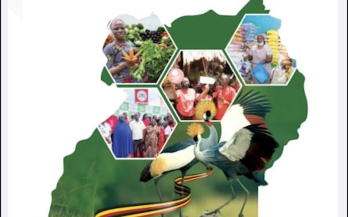
Uganda is entering a decisive phase in its journey toward achieving a USD 500 billion economy by 2040, as envisioned under the Tenfold Growth Strategy and National Development Plan IV (NDP IV). Both frameworks emphasize sustainable industrialization for inclusive growth, employment, and wealth creation.
However, the success of this economic transformation rests on the vibrancy, competitiveness, and quality orientation of the private sector particularly Micro, Small, and Medium Enterprises (MSMEs). MSMEs account for 98.8% of Uganda’s enterprises, contribute 75% of GDP, 77% of formal jobs, and generate 80% of domestic revenue. They are the backbone of Uganda’s economic fabric and the engine of future industrialization. Despite this importance, MSMEs face persistent challenges—limited access to finance, low productivity, weak innovation, and poor compliance with standards. Furthermore, the MSME Policy (2015) and the National Standards and Quality Policy (2012) have become outdated amid evolving national, regional, and continental priorities, including the AfCFTA, the EAC Industrialization Strategy (2021–2031), digital transformation, and sustainability imperatives
Community of Practice: Bringing together entrepreneurs for better food systems in Nigeria
As the world marks Global Entrepreneurship Week 2025 under the theme “Together We Build,” the SUN Business Network (SBN) Nigeria is taking a bold step toward strengthening collaboration among entrepreneurs driving change in the food system. With the recent launch of its website and Community of Practice, SBN Nigeria is creating a vibrant space where nutrition-focused businesses can learn, connect, and grow together. This milestone represents more than a digital achievement, it’s a movement toward building a community where shared ideas fuel innovation, partnerships inspire action, and entrepreneurs collectively shape a healthier, more resilient food system for Nigeria.
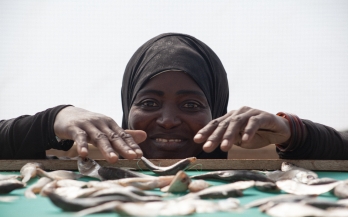
Moma, Mozambique – When Islova Alberto Aly decided to venture into fish drying, her primary aim was to generate an income to support her children's education. Little did she know that her traditional fish drying methods—spreading fish on the ground by the Mucoroge beach, exposed to sand, dust, sun, and bacteria—would harm her community.
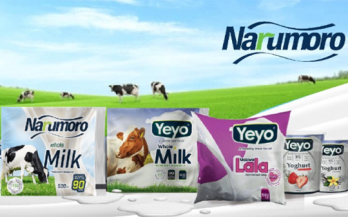
Incofin Investment Management and the Global Alliance for Improved Nutrition (GAIN), through the fund ‘Nutritious Foods Financing Facility (N3F)’, announce two new investments in East Africa’s dairy sector: Mujuni Ventures Limited in Uganda and Narumoro Dairy in Kenya.
These investments will improve access to nutritious foods for underserved populations, while strengthening local food systems and supporting smallholder farmers. With these additions, the Fund now counts ten active investments across Sub-Saharan Africa.
Every October, the world comes together to mark World Food Day, a moment to reflect on progress and renew our commitment to building food systems that nourish everyone. The 2025 theme, “Hand in Hand for Better Foods and a Better Future,” speaks to the power of collaboration. At GAIN Nigeria, we see this play out every day in our partnerships across governments, industry, and civil society. It is not just about what we do as an organization it is about what we achieve together. One powerful example of this is the Digital Fortification Quality Traceability Plus platform (DFQT+) platform, now transforming how fortified foods are monitored in Nigeria.
Youth in Tanzania are active at the community level but remain largely absent from formal
governance. There is potential for Tanzanian youth to more actively help Tanzania in its ambition to
achieve a nutrition-sensitive, climate resilient, inclusive food system.
KEY MESSAGES
Children in both urban and rural Ethiopia are increasingly consuming ultra-processed foods that contain unhealthy levels of sugar, salt, and unhealthy fats. These items, heavily marketed and widely accessible, are rapidly replacing traditional healthy diets.
Inadequate and unhealthy diets during childhood can compromise physical and cognitive development, diminish immune function, and increase susceptibility to chronic illnesses later in life.
Priority policy areas the government should consider include: more nutrition education; improved regulation of the food environment to make healthy options more prominent and unhealthy options less prominent; subsidies that prioritize healthy diets for children; and improved coordination and coherence across sectors seeking to transform food systems (e.g. Agriculture, Education, Health, and Trade).
Reducing unhealthy diets in children is not just a nutrition issue – it’s a systems issue. Ethiopia must urgently implement a coordinated, multi-sectoral strategy with actions to ensure all children have access to diverse, healthy, safe, and affordable diets from the start of life.
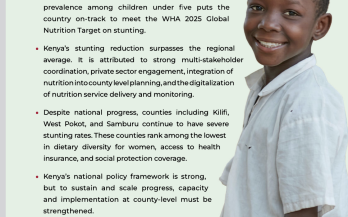
Stunting is a major concern in Eastern Africa, where nearly 1 in 3 children under 5, about 22.6 million, are
affected (UNICEF, WHO, Worldbank, 2023). In Kenya, the prevalence has declined to approximately one in
five children (18%), outperforming the regional average of 31.6%. However, this still represents more than
1.2 million children at risk (KNBS, Ministry of Health, ICF, 2023). The consequences are far-reaching;
stunting contributes to child mortality, vulnerability, and lifelong impairments in physical growth and
cognitive development, impacting both individual well-being and national productivity. In Kenya, child
undernutrition, including stunting as a key component, is estimated to cost the economy KES 374 billion
(approximately USD 4.2 billion) annually, equivalent to 6.9% of the GDP (Government of Kenya, 2019).
Stunting, a persistent form of long-term nutritional deprivation, acts as a silent driver of inequality, limiting
opportunities, lowering future earnings and reducing the potential to contribute equally to the economy.
Yet the returns on investment in nutrition are high, with every dollar yielding up to $22 in economic
benefit. (Eberwein, et al., 2016)
As we prepare for the 2025 Global Forum (13 – 17 October) marking ten years of the Milan Urban Food Policy Pact, we're bringing insights from our work across Africa and Asia on how city governments and local food markets can transform urban food environments and wider food systems.
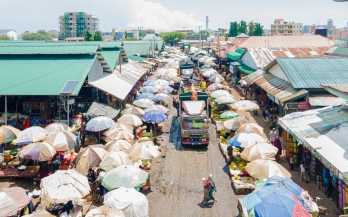
Walking through any bustling urban food market, from Pemba (Mozambique) to Arusha (Tanzania) and Bogor (Indonesia), is a remarkable experience. Beyond the offerings of fresh, dried, iced and frozen produce, spices, cooked traditional meals, and animated negotiations between vendors and customers, the experience of the market is at the nexus of food systems and nutrition policies and daily realities. These markets are about more than selling and buying food; they are where the future of food systems, within cities and across urban–rural landscapes, borders, and territories, is being lived, innovated, and imagined.