- 22/06/2026
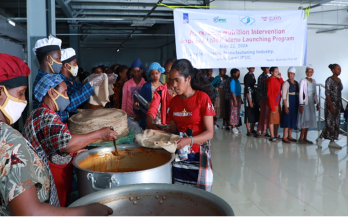
Workplace food provision represents a significant opportunity to improve diet quality among working-age adults. This working paper synthesises cross-country experience from GAIN-supported programmes in Bangladesh, Ethiopia, and Uganda on how improved workplace menus have been assessed, designed, and operationalised.
- 18/05/2026
Uganda increasingly recognises the importance of addressing the intersection of climate change and nutrition, with emerging efforts demonstrating that integrated action is both possible and already underway. However, climate shocks, including droughts, floods, and pest outbreaks, continue to disrupt food production, dietary diversity, water access, and disease patterns, ultimately undermining nutrition outcomes. A review of 39 national policies and consultations with 22 stakeholders across government, development partners, civil society, and the private sector reveal that climate and nutrition remain largely siloed within Uganda’s policy architecture, and that implementation is constrained by gaps between policy intent and operational reality.
However, a subset of policies demonstrates that effective climate–nutrition integration is already possible, particularly where clear pathways, costed commitments, and system-level investments are in place. Stakeholder interviews indicate that, although policy frameworks increasingly acknowledge the climate-nutrition nexus, integrated action is most often realised at the program level, primarily through donor-funded projects and civil society initiatives, rather than systematically embedded within government systems. These findings highlight a critical opportunity to strengthen policy coherence, institutional coordination, financing alignment, and cross-sector accountability to accelerate climate-nutrition integration efforts in Uganda.
- 16/05/2025
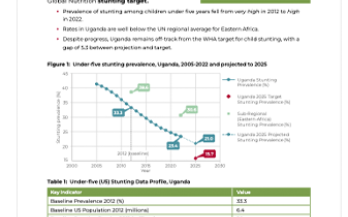
WHA Global Nutrition Stunting Target 2012-2025
Achieve a 40% reduction in the number of children under-5 who are stunted
WHA Global Nutrition Overweight Target 2012-2025
Ensure that there is no increase in childhood overweight
- 09/04/2025
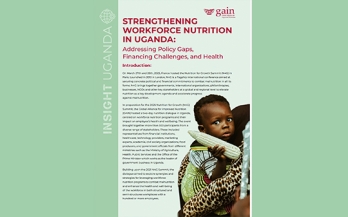
On March 27th and 28th, 2025, France hosted the Nutrition for Growth Summit (N4G) in Paris. Launched in 2013 in London, N4G is a flagship international conference aimed at securing concrete political and financial commitments to combat malnutrition in all its forms. N4G brings together governments, international organisations, philanthropies, businesses, NGOs and other key stakeholders at a global and regional level to elevate nutrition as a key development agenda and accelerate progress against malnutrition. In preparation for the 2025 Nutrition for Growth (N4G) Summit, the Global Alliance for Improved Nutrition (GAIN) hosted a two-day nutrition dialogue in Uganda, centred on workforce nutrition programs and their impact on employee’s health and wellbeing.
- 11/05/2023
Uganda is a low-income country in which 41% of the population lives below the poverty line, and where about 82% of the population cannot afford a healthy diet. There is a continued need to engage all actors and options to address the malnutrition burden the world faces.
- 13/06/2020
Food fortification is implemented to increase intakes of specific nutrients in the diet, but contributions of fortified foods to nutrient intakes are rarely quantified.
- 01/09/2017
The goal of this study was to develop and test two methods of quantitative dietary assessment that are less technically challenging and less expensive to implement than the standard 24HR dietary recall procedure, but still capable of identifying nutrient gaps with acceptable precision.
- 01/05/2010
The Uganda Food Consumption Survey was undertaken to provide the critical body of evidence that policy makers and program designers need to make informed decisions about effective investments to reduce deficiencies of vitamins and minerals in Uganda.
- 01/02/2017
The purpose of the survey was to assess the household coverage and potential contribution of fortified foods to the micronutrient intake among women of reproductive age in Uganda.
- 01/11/2017
This report presents the results of that assessment and proposes a Consumption Monitoring and Surveillance Framework consisting of the various processes, phases, components, and domains that provide an enabling environment for this to happen.