- 11/04/2023
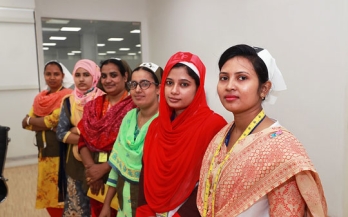
In 2019, in an effort to improve the efficiency and sustainability of its programming, GAIN’s Workforce Nutrition Programme (WFN) shifted away from the traditional project development and evaluation cycle towards a nimbler "Quality Improvement" (QI) approach.
- 21/04/2023
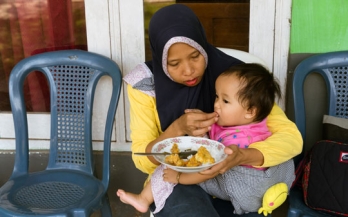
Micronutrient deficiencies (also known as hidden hunger) are a significant public health problem globally. Pre-pandemic estimates found 1 in 2 children and 2 in 3 women suffering from a micronutrient deficiency. Levels of deficiency are likely to be even higher today given the protracted global food crisis arising from the COVID pandemic and Russia’s invasion of Ukraine.
- 13/04/2023
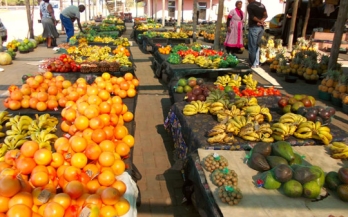
This paper discusses the critical importance of expanding 'food systems infrastructure' as a necessary pre-condition for improving access to healthy and sustainable diets in low- and middle-income countries. It proposes a tractable definition of food systems infrastructure, highlights deficits that have yet to be addressed, and lays out a generic way forward to accelerate infrastructure accumulation.
- 23/03/2023
The review demonstrates that designing policies to holistically address underlying drivers of inequity would require data disaggregated at the level of relevant social groups, with adequate geographic granularity, as well as qualitative data from the perspectives of affected people spanning food environments, socioeconomic information, and the food security, nutrition, and health issues that policies target.
- 21/12/2022
In advance of the 2022 AGRF Summit, the Global Alliance for Improved Nutrition (GAIN) and AGRA produced a report to provide African leaders with cutting-edge data tools to do just this. This briefing paper summarises the main results of that effort.
- 09/11/2022
Climate change impacts and risks are becoming increasingly complex and more difficult to manage. Simultaneously, the world is facing the complex challenges of hunger and multiple forms of malnutrition.
- 03/11/2022
The global food system is experiencing the worst crisis in history. Unlike the food price crisis of 2007-8, in 2022 there is a convergence of multiple crises. Hunger and malnutrition have soared in the wake of the coronavirus pandemic (COVID-19).
- 18/10/2022
Nutrition for Growth (N4G) is a Summit held every four years alongside the Olympic Games to galvanise global actions to tackle malnutrition.
- 31/10/2022
In line with our Environment Strategy, we aim to do the following at COP27 - Highlight the need for coordinated and integrated action on climate and nutrition to prevent disastrous increases in food insecurity and malnutrition resulting from climate change
- 11/10/2022
Today, more than 125 countries have mandatory food fortification programmes. Food fortification requires a "premix" – a mixture of vitamins and minerals – that can then be added to various staple products.