- 22/07/2024
Environmental factors impact human health and nutrition through various pathways, and these impacts can be felt disproportionately by already vulnerable groups like women and children.
- 20/06/2024
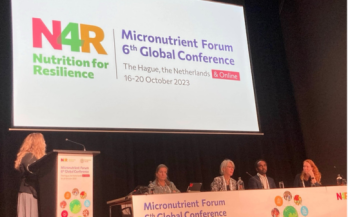
A symposium on local Dutch and international experiences of multisectoral food security and nutrition initiatives was held at the Micronutrient Forum 6th Global Conference, on 16 October 2023 in The Hague (The Netherlands). Three case studies - one each from Ghana, Ethiopia, and The Netherlands - were presented.
- 20/06/2024
Biofortification (also known as nutrient enrichment) of staple crops, is a cost-effective and sustainable agricultural technology that enhances the quantity, bioavailability and bioaccessibility of micronutrients, with the aim of reducing micronutrient deficiencies. From 2019-2022, GAIN and HarvestPlus coordinated the Commercialisation of Biofortified Crops (CBC) Programme, which sought to scale up the production and consumption of biofortified foods (i.e., wheat, maize, cassava, rice, pearl millet, and beans) through commercial pathways in six countries in Africa and Asia. The programme used a variety of strategic scaling pathways to ensure commercialisation (e.g., increased production and availability of surplus for sale in markets), where aggregation was a key step. The objectives of this paper are to: (1) document the types of aggregation models employed by the CBC programme and their challenges, and (2) make recommendations for improving biofortified crop value chains to better achieve commercialisation. The insights in this paper are based on a desk review of CBC programme documents and semi-structured interviews with programme implementers.
- 06/06/2024
To ensure the success of LSFF, governments can establish and strengthen national mandatory fortification standards as well as regulatory frameworks that ensure access to high-quality fortified foods across the entire population. Strong regulations also help ensure a level playing field for fortified food producers where all are held to the same standard.
- 18/04/2024
To scale up the production and consumption of biofortified foods through commercialisation, GAIN and
HarvestPlus partnered in 2019 to implement the Commercialisation of Biofortified Crops (CBC)
Programme
- 30/04/2024
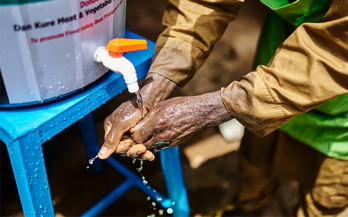
EatSafe: Evidence and Action Towards Safe, Nutritious Food (EatSafe) is a USAID Feed
the Future programme that works in traditional markets in Nigeria and Ethiopia to
improve food safety.
- 29/05/2024
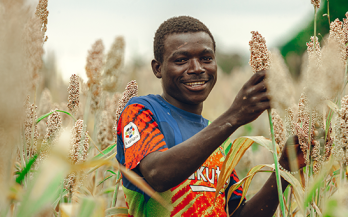
Overreliance on a few main crops, as well as poor soil health, reduce yields, hinder achievement of food security and nutrition objectives, and increase agricultural vulnerability to climate change. To address this, the Vision for Adapted Crops and Soils (VACS), launched by the United States in partnership with FAO and the African Union, and as part of the whole-of-government Feed the Future initiative, seeks to support soil health as well as breeding of traditional and indigenous crops in Africa.
- 29/05/2024
Foodborne disease is a major global health challenge, causing millions of illnesses every year – mostly in low- and middle-income countries – and hindering achievement of other global goals, such as improved nutrition. Since contamination of food can happen at any point ‘from farm to fork’, reducing the burden of foodborne illness requires a whole-of-food-system approach: one that considers all actors and activities that play a role in production, processing, distribution, preparation, and consumption of food. The objective of this paper is to discuss how to enact such a food system approach to food safety, with a focus on LMICs.
- 18/04/2024
In 2023, Criterion Institute and UNICEF partnered to develop child lens investing: an emerging field that intentionally integrates considerations of child rights and wellbeing into investment processes. Understanding is growing of the opportunity that exists for increasing economic, social, and environmental impact by considering children when making investments.
- 22/04/2024
In a perfect world, functional food systems would provide multiple benefits for everyone, including healthy diets, environmental sustainability, and improved livelihoods . Unfortunately, we live in a far from perfect world. Over three billion people cannot afford a healthy diet, some 735 million people face hunger, and obesity rates are on the rise .