When Faith Meets Food: Lessons from the Food Culture Alliance Indonesia's Collaboration with Catholic Institutions
Indonesia, 28th May 2026
Indonesia, 28th May 2026
T here is something quietly powerful about institutions that have spent centuries mastering the art of storytelling. Long before food systems became a policy agenda, religious communities were already doing something that nutrition programmes have long struggled to achieve: making people feel something about what they consume, share, and value.
This is precisely why the Food Culture Alliance (FCA) Indonesia made religious institutions one of its five food culture institution pillars — and why our partnership with the Catholic sector in Jakarta has become one of the most instructive collaborations in our portfolio to date.
Since 2025, the Food Culture Alliance Indonesia has been in active stakeholder engagement with the Archdiocese of Jakarta (Keuskupan Agung Jakarta) and Wanita Katolik Republik Indonesia (WKRI), the Indonesian Catholic Women's Organisation. What began as a deep-dive exploration of how religious institutions shape food culture gradually grew into a formal strategic partnership formalised in 2026.
This collaboration is led on the ground by Jaqualine from Eathink and Debrina Adisty from the FCA Indonesia Secretariat, with programme cycle integrity and FCA intellectual property stewardship maintained throughout to ensure the work remains aligned with GAIN's strategic framework and the FCA's developed methodology.
WKRI DPD Jakarta — the regional chapter covering Greater Jakarta — is no small actor. With 66 branches and approximately 17,500 members, all women and predominantly adults above 40 years of age, WKRI represents a deeply rooted social infrastructure. (Younger Catholic women are typically organised under a separate body, Orang Muda Katolik.) This is not a passive membership base; these are women who are embedded in their communities, trusted by their families and parishes, and already functioning as informal influencers of household food decisions every single day.
The question we brought to this partnership was straightforward: How do we turn that existing influence into intentional storytelling for nutritious and sustainable food?
In 2026, FCA Indonesia shifted its phase of work towards Shaping Narrative — a methodology centred on harnessing the power of storytelling to create emotional schemas that shift food culture from the inside out. The premise is simple but profound: narrative is not merely communication; it is the mechanism through which values are transmitted across generations.
We begin with local food (pangan lokal) deliberately. In Indonesia, local food is not simply an agricultural category — it is memory, identity, and relationship. It sits closer to the lived food system narrative than any imported concept of "healthy eating" ever could. When someone tells the story of a tempeh recipe passed down from their grandmother, they are not just sharing a dish; they are transmitting culture.
The FCA's Shaping Narrative approach is designed so that anyone can become a storyteller. This is critical. We are not looking to produce polished brand ambassadors. We are building a distributed ecosystem of authentic voices — each one rooted in their own lived experience with food.
For WKRI Jakarta, this resonated deeply. Catholic institutions are, in many ways, already fluent in narrative. Parables and metaphors are not rhetorical devices for them — they are foundational pedagogical tools used to embed values that touch the conscience (sanubari). The alignment between FCA's storytelling methodology and WKRI's institutional communication culture was not incidental; it was structural.
April 2026 — Storytelling Training, Coinciding with National Women's Day (Hari Kartini)
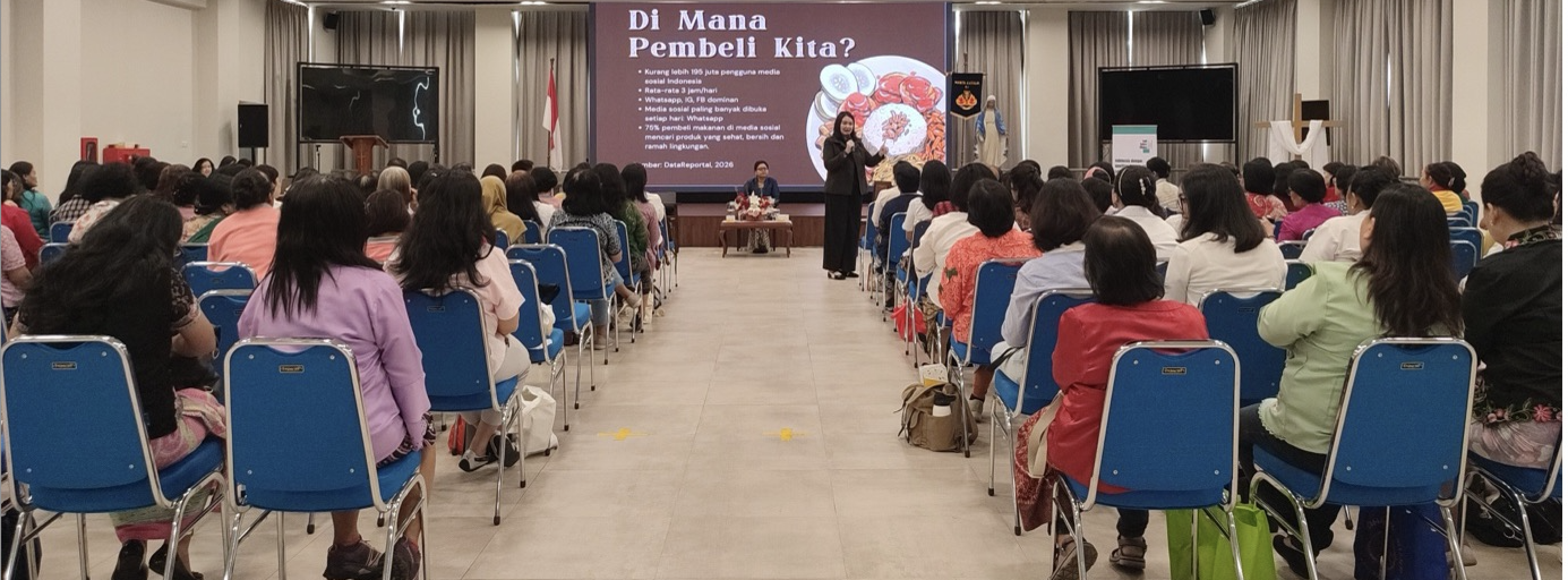
On Saturday, 18 April 2026, we opened the first activity: a storytelling training workshop for WKRI branch representatives. The session introduced participants to storytelling as a communication tool — covering narrative structure, psychological engagement with prospective audiences, and the emotional dimensions of food memory.
We drew explicitly on the narrative devices already familiar to the participants: parables and metaphors that religious institutions use to root values and norms. To these, we added two additional elements specific to food storytelling — nostalgia and process. How was this product made? Is there a family recipe behind it? What does it mean to the person making it?
The session came alive when one participant — an ibu who makes and sells salted eggs (telur asin) — shared her experience. Before the training, she had been communicating her product using straightforward, transactional language: ingredients, technique, price. After engaging with the storytelling framework, she began to share the process — the waiting, the craft, the story behind how she learnt it. The room shifted. Other participants leaned in. The energy changed visibly.
That moment demonstrated something we know conceptually but rarely see so clearly: emotional truth is contagious. And when it spreads, it motivates.
The session was also a celebration of identity. Held in conjunction with Hari Kartini — Indonesia's National Women's Day — participants were invited to attend in traditional kebaya, honouring the legacy of Raden Adjeng Kartini and the enduring strength of Indonesian women as cultural custodians.
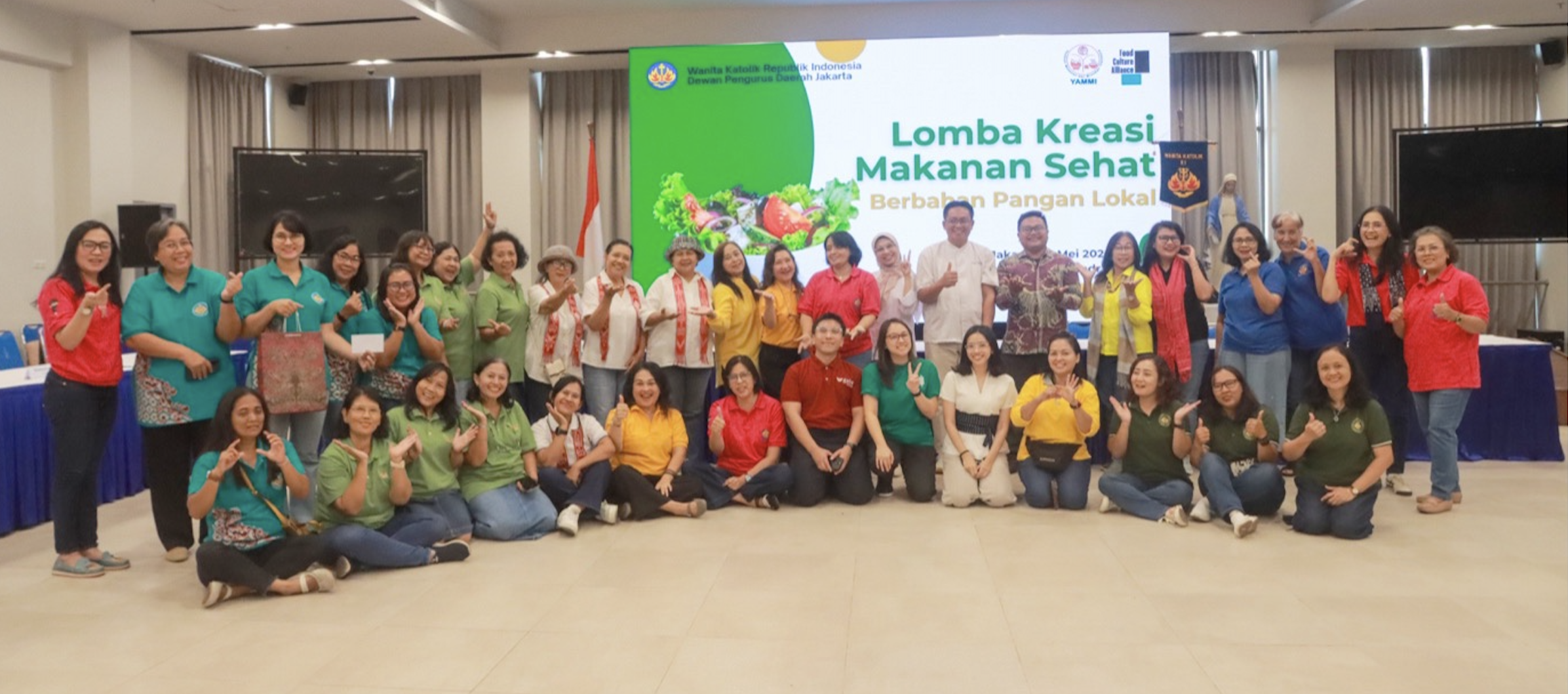
One month later, on Saturday, 16 May 2026, participants returned — this time to compete.
The structure was intentional. Giving participants a full month between training and competition allowed them to practise, refine, and internalise what they had learnt. Each branch was invited to send one representative to tell the story of their local food UMKM (micro, small and medium enterprise) product. Approximately 20 of the 66 invited branches participated, with both a pre-recorded video component and a live storytelling performance.
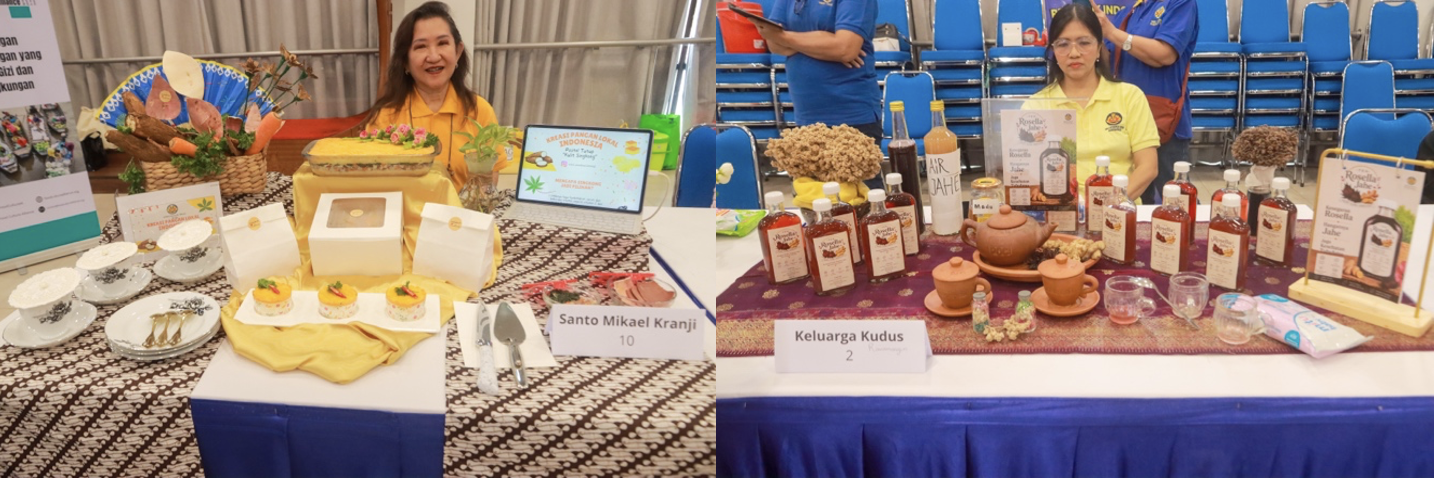
The menu offerings were genuinely innovative — local-ingredient-based food and beverage products with real market potential. But the judging criteria placed the greatest weight on storytelling quality, not product presentation. Participants had to demonstrate that they could use the FCA's narrative framework to make their product mean something to an audience.
We designed the entire process to be as accessible as possible. The majority of participants are women above 40 years old — experienced, capable, and entirely capable of deep emotional communication, but not always familiar with structured communication frameworks. Simplicity was not condescension; it was respect.
Perhaps the most significant development came not from within the programme itself, but from who was watching.
Representatives from the Commission for Socio-Economic Development (PSE) of the Archdiocese of Jakarta took note. There is now an active request to co-design a longer-term programme with FCA Indonesia — one that would enable the Archdiocese to implement the Bishop's directive on Ecological Conversion (Pertobatan Ekologis), embedded in the Archdiocese's foundational strategic guidelines (Arahan Dasar/Ardas) for 2026.
The aspiration is ambitious and deeply aligned with FCA's urban food system agenda: to expand the collaboration across Jakarta's parishes, demonstrating the role of the Catholic community in shaping the city's food sovereignty and embedding nutritious, environmentally responsible food as an urban cultural preference.
One. Religious institutions are not peripheral to food systems work — they are one of its most underutilised infrastructures.
They hold trust, reach, and centuries of experience in value transmission. Meeting them on their own terms, through the language of narrative and meaning, is both strategic and respectful.
Two. Storytelling is a scalable intervention when it is structured correctly. The FCA's Shaping Narrative methodology is not about training professional communicators.
It is about helping people recognise and articulate the stories they already carry. In Indonesia, local food is the most natural entry point for this.
Three. Programme benefit must be mutual. WKRI branches are not simply vehicles for FCA's narrative agenda. The collaboration is designed so that stronger storytelling translates into stronger product communication, which in turn supports branch-level income generation and sustainable financing. Alignment of purpose with alignment of benefit is what makes a partnership last.
Four. Strategic patience in stakeholder engagement pays off. The Archdiocese and WKRI partnership did not materialise overnight. It was built through genuine engagement beginning in 2025, through listening as much as proposing, and through demonstrating that the FCA's institutional framework offered something meaningful — not just for nutrition outcomes, but for their own organisational missions. The conversation between faith and food in Jakarta is just beginning. We are glad to be part of it.

Project Coordinator for Food Culture Alliance