
Stella Nordhagen
Research Lead, Food Environments and Supply Chains
Blog
‘How might AI affect jobs in the food system?’ It was an intriguing question that came up in a recent office conversation — and one that is directly relevant to GAIN’s work that supports equitable and high-quality employment in food systems.
‘How might AI affect jobs in the food system?’ It was an intriguing question that came up in a recent office conversation — and one that is directly relevant to GAIN’s work that supports equitable and high-quality employment in food systems.
The rise of generative Artificial Intelligence (genAI) in recent years has led to excitement about the potential for higher productivity and new possibilities for what humans, helped by machines, can do – but also to anxiety about job loss, displacement, and inequitable outcomes for workers. This is no less acute in the food system, which employs about 1.2 billion people globally but already faces challenges with retaining workers, recruiting younger generations, and providing not just work but high-quality livelihoods. Bringing genAI into the mix could complicate an already challenging puzzle.
The data
Fortunately, beyond just coffee break speculation, there’s data we can bring to answer this question. The International Labour Organization (ILO) and NASK, Poland’s National Research Institute, have developed a dataset that scores hundreds of occupations for their exposure to genAI automation.
This is based on a database of tasks associated with standard occupations — a global one, ISCO-08, containing 3,265 tasks for 427 occupations, and a Polish one containing nearly 30,000 tasks for about 2,500 occupations.
Using this, ILO/NASK surveyed Polish workers on the automatability of tasks associated with their own jobs; labour market experts then reviewed a subset of these task scores; where expert and survey scores diverged, two LLMs served as arbiters to produce an adjusted task score; and a predictive model was used to expand the scores to the full database of thousands of tasks. These task-level scores were then aggregated to the level of an occupation, considering both the mean ‘automatability’ of tasks and the standard deviation in that—representing the variability of tasks within the occupation.These were then classified into six categories: from not exposed (very low automation potential) to high exposure across tasks, with low task variability.
But the ILO dataset covers occupations across the whole economy, not just food. To classify those related to the food system, we used Claude (Sonnet 5) to flag occupations in the food system. The author reviewed these and reclassified as needed. Where gaps were identified, occupations were added using the nearest proxy in the ISCO-08 data (e.g., ‘Messengers, Package Deliverers and Luggage Porters’ as a proxy for food delivery drivers)
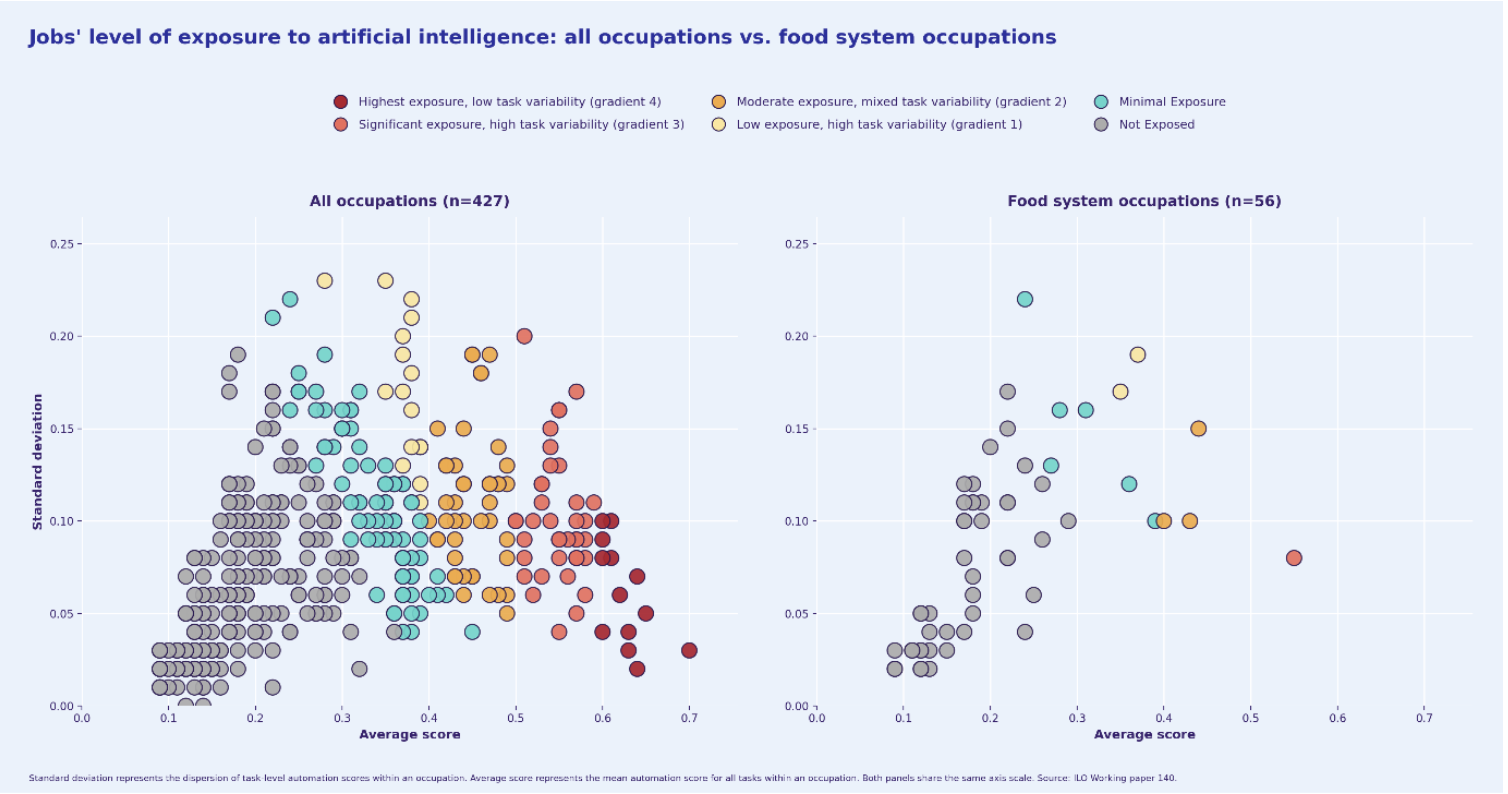
As shown in the interactive figure above, most occupations, like fishers, food processing plant workers, and farmers, are considered ‘not exposed’, with a handful having minimal or low exposure, for example waiters, food lorry drivers, and only a few, retail and wholesale food trade managers, grocery shopkeepers, food technologists, agronomists and crop scientists, having moderate exposure. Only one has significant exposure, food systems researchers, proxied by ‘economists’, and none have high exposure.
This is in stark contrast to the ILO results for the economy as a whole, which show considerably larger shares of occupations in the moderate, significant, and high exposure categories, for roles like typists, accountants, and medical records technicians.
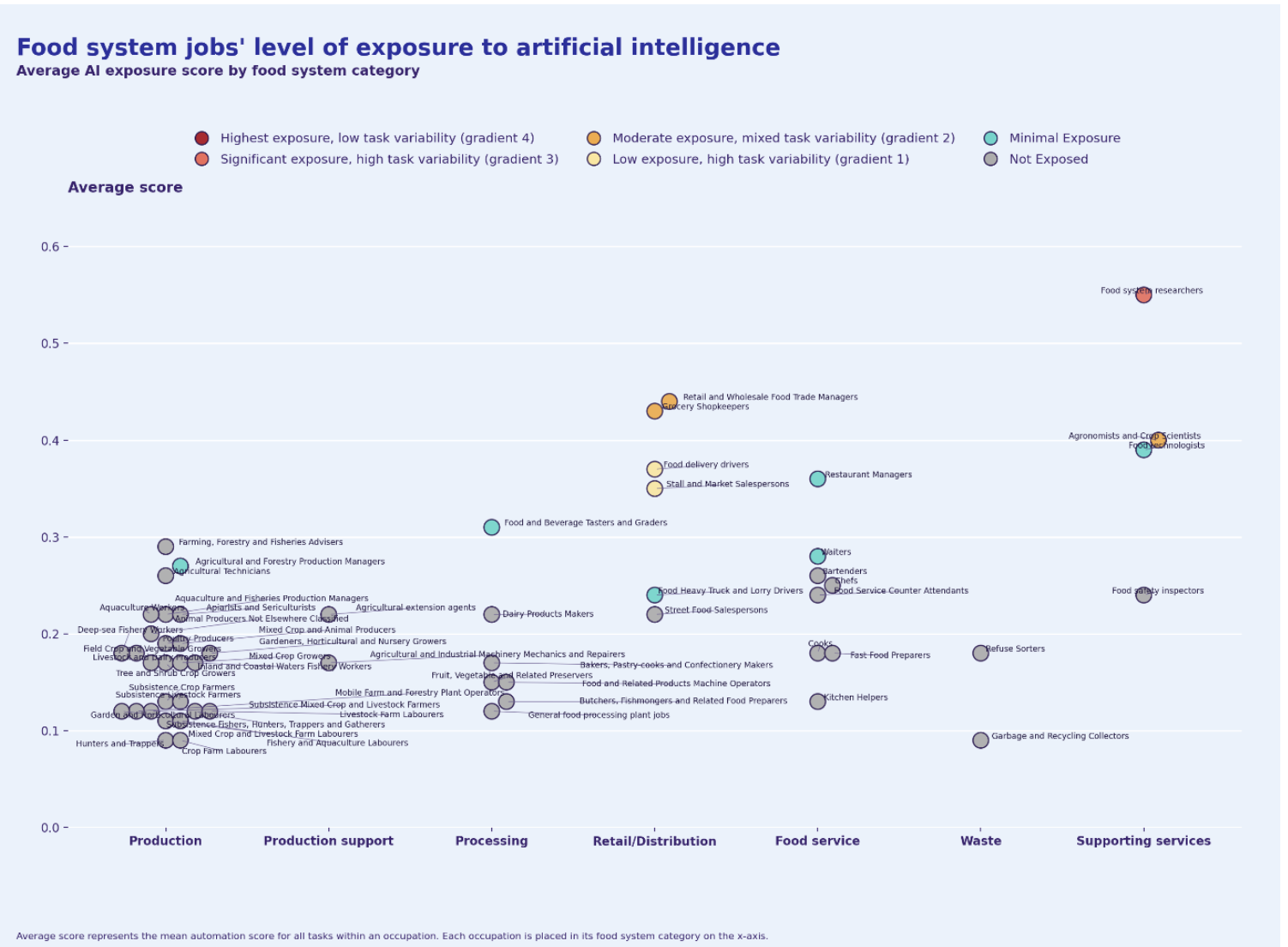
Looking at how the jobs map to the different parts of the food system makes it clear that the more exposed jobs tend to be in the retail/distribution and supporting services sectors, with those in food production, production support, and processing having almost no exposure.
But ease of automation isn’t the only lens through which to consider how jobs might be affected by genAI. A group at Harvard Business School has analysed the question considering not only automation but also augmentation — the possibility for genAI to complement human work in occupations that include a mix of automatable and non-automatable tasks. Their data are similar to the ILO data in terms of being based on the automatability of tasks with occupations, but differ in the occupation-task database used, covering 911 occupations in the U.S., and how they were classified.
Again, the data were not food system-focused, so we used Claude to classify them and filled in gaps, as above. The data are a bit different than those of the ILO in that they have many fewer roles in basic production but many more in food service, processing, and research.
The results show a similar picture in that many jobs have low levels of automation risk, vertical axis in the graph below, with a maximum possible value of 1.0, but others have moderate risk — particularly those in supporting services like research. However, they also highlight the potential: many jobs have significant opportunities for being augmented by AI, near 0.5, the maximum value for ‘augmentation potential’. For example, a restaurant hostess might be able to use AI to better manage table configurations and availability and match that to waiting diners — but she would still need to bring the human touch of welcoming diners to the restaurant, making them feel cared for, and manage unexpected real-world incidents like needing to re-seat a party due to a ceiling leak. And these ‘high augmentation potential’ jobs exist all across the food system, from production to food service.
There are limitations to this analysis: task lists in a database don’t represent the entirety of an occupation, the data overrepresent high-income countries (Poland and the U.S.), some occupation titles include both food and non-food work (e.g., ‘hunters and trappers’, ‘refuse and recycling collectors’), some occupations are debatable in terms of whether they are part of the food system (e.g., ‘dieticians and nutritionists’, whose work relates directly to food but within the health system; ‘veterinarians’, who are essential in caring for livestock – but also care for other animals), and the proxies used are imperfect. And most importantly, there are many more unknowns than knowns when it comes to the future development of AI.
But it does provide some insight. The food system as a whole seems relatively insulated from the employment-displacement effects of genAI, but it is not immune—particularly for the knowledge-intensive supporting services jobs like research, which also tend to be better paid than those in primary production and processing. The risks of genAI displacement should be part of future conversations on food system employment—keeping in mind that jobs are often more than just a source of income, but also relate to identity and social roles.
Jobs across the food system also show potential for genAI augmentation—which could potentially improve workers’ productivity as well as their job satisfaction. But this won’t happen by accident: food system workers will need relevant AI tools, based on locally appropriate training data. Deliberate efforts will be needed to make these tools inclusive and their uptake equitable, particularly as many food systems workers are on low wages, migrants, or otherwise marginalised. There will also be a need for better training, to ensure workers have the skills to leverage genAI, ideally in a way that can make their work more fulfilling by removing rote tasks while maintaining human agency and decision-making.
Research Lead, Food Environments and Supply Chains